

Sustainability · 2025
In this section52 topics
- Sustainability Policy3 items
- Sustainability Goals & UN SDGs3 items
- Policy Review3 items
- Business Value Chain1 item
- Stakeholder Analysis1 item
- Environmental Policy & Guidelines4 items
- Environmental Policy Review3 items
- Energy — Plan & Guidelines3 items
- Energy — Electricity Consumption1 item
- Energy — Fuel Consumption1 item
- Energy — Targets2 items
- Energy — Performance & Outcomes2 items
- Water — Plan & Guidelines2 items
- Water — Withdrawal, Discharge & Consumption1 item
- Water — Targets2 items
- Water — Performance & Outcomes2 items
- Waste — Plan & Guidelines2 items
- Waste — Generation, Disposal & Recycling1 item
- Waste — Targets2 items
- Waste — Performance & Outcomes2 items
- GHG — Plan & Guidelines2 items
- GHG — Emissions1 item
- GHG — Emissions Verification4 items
- GHG — Principles & Standards1 item
- GHG — Targets1 item
- GHG Targets — Net Zero1 item
- GHG — Performance & Outcomes2 items
- Environmental Legal Incidents1 item
- Other Environmental Management1 item
- Social Policy & Guidelines3 items
- Social Policy Review3 items
- Social — Principles & Standards Practised1 item
- Human Rights Due Diligence2 items
- Employees — Plan & Guidelines5 items
- Employees — Workforce1 item
- Employees — Remuneration & Provident Fund1 item
- Employees — Training & Development1 item
- Employees — Occupational Health & Safety1 item
- Employees — Labour Relations1 item
- Employees — Employee Representation2 items
- Employees — Targets2 items
- Employees — Performance & Outcomes2 items
- Customers — Plan & Guidelines3 items
- Customers — Satisfaction Results1 item
- Customers — Targets2 items
- Customers — Performance & Outcomes2 items
- Community & Social — Plan & Guidelines3 items
- Community & Social — Targets2 items
- Community & Social — Performance & Outcomes2 items
- Other Social Management1 item
- Law Violation Incidents1 item
- Law Violations — Case Detail & Corrective Measures1 item
Sustainability Policy
Has a Sustainability Policy
Yes
Policy Description
Sustainability Management Policies and Targets
Vision
To be a leading real estate developer in the region, committed to creating a better and more sustainable future for all.
Purpose
Sustainable Future
To grow toward a sustainable future by becoming the center of life and communities.
Central Pattana Beliefs - Driving Shared Success
Dynamism – Continuous Development
We are driven by an unwavering commitment to development, creativity, and confidence in our ability to improve quality of life for all. We embrace challenges, set ambitious goals, and persevere through obstacles. Guided by innovation to advance the world around us, we are pioneers who understand others, dare to try new approaches, and encourage people to express their ideas. Our expertise, curiosity, and forward-thinking mindset continuously fuel learning and progress.
Customers – Customers as Our Inspiration
Our customers—including shopping center visitors, tenants, residents, and partners—are the inspiration behind everything we do. Every employee plays a key role in supporting customers at every touchpoint, consistently delivering excellence that exceeds expectations today and in the future.
Communities – Creating Value for All Stakeholders
We are an integral part of communities, society, and the world, where people come together to create shared value and improve quality of life. By prioritizing all stakeholder groups, we are committed to creating value at every step—guided by shared goals for communities, society, and the planet—in order to achieve sustainable mutual success.
Collaboration – Achieving Success Together
We grow through learning, experimentation, and collaboration. We take a holistic approach that considers colleagues, teams, business units, customers, communities, current and future partners, and broader collaborative networks. Together, we play an active role in delivering long-term success and realizing our shared vision.
About Central Pattana
The Company operates in real estate development and related businesses across three core segments:
Rental and Service Business: large-scale and small-scale shopping centers, food courts, offices
Hotel business
Residential business for sale
These three business segments are interconnected within an integrated ecosystem. The Company’s headquarters is located in Bangkok. Over 99% of operations are in Thailand, with one shopping center located in Malaysia.
The Company conducts its business in accordance with good corporate governance principles, emphasizing transparency, fairness, accountability, and responsibility toward all stakeholders, guided by sustainability across three dimensions: economic, social, and environmental. The United Nations Sustainable Development Goals (SDGs) serve as a guiding framework for defining sustainability-driven business objectives and enabling tangible implementation throughout the Company’s value chain.
Central Pattana's Sustainability Strategy
The Company defines its strategic direction by creating a business ecosystem that supports a 360-degree lifestyle for all groups, under the purpose “The Place-maker for a Sustainable Future.” Strategic planning considers changes in the business environment, stakeholder expectations, and organizational readiness, integrating sustainability dimensions—social, environmental, and financial—through executive strategy workshops and annual review and approval by the Board of Directors.
Core Strategy and Long-Term Growth Direction
The Company has adopted the “3 Businesses x 3 Enablers (33 Strategy)” framework comprising: Core Businesses, including : (1) Retail Development, (2) Other Real Estate Development (residential, office, hotel), (3) New Businesses, and Key Enablers, including : (1) Digital Technology, Data, and AI, (2) Sustainability Development, (3) Human Capital. The long-term business strategy (2025–2030) focuses on:
Enhancing long-term asset value through effective asset management, operational efficiency, and asset life extension
Expanding investment both domestically and internationally in high-potential locations
Driving organizational transformation through agile structures, innovation, and technology
Identifying and scaling new business opportunities aligned with global trends (New S-Curve)
Integrating a collaborative business ecosystem across the value chain to create positive social and environmental impacts
ESG Sustainability Management Strategy
Central Pattana drives sustainability under a robust governance structure, with the Corporate Governance and Sustainable Development Committee serving as the principal oversight mechanism. Sustainability strategies are reviewed annually and integrated into both short- and long-term business planning, with initial focus on retail and office businesses and progressive expansion to other segments.
Environmental Dimension : Environment – Enhance a Better Planet
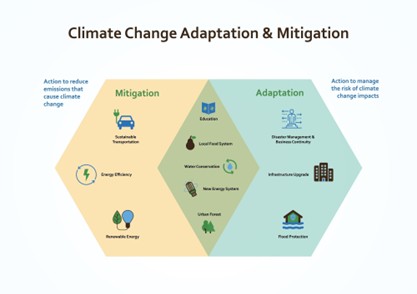
The Company aims to become an environmental role model through the implementation of a Climate Transition Plan, expanding upon its Net Zero Pathway to address both mitigation and adaptation comprehensively.
Key Objective: Achieve Net Zero greenhouse gas emissions, with a 46.2% reduction by 2030 and a 90% reduction by 2050 (compared to the 2019 base year).
Driving Strategies: Climate Transition Plan, comprising 3 core driving strategies:
1. Climate Mitigation: Journey to Net Zero - Focused on reducing Scope 1 & 2 greenhouse gas emissions:
Accelerate Energy Efficiency improvements in shopping centers and office buildings through Smart Building technology
Transition fully to Clean Energy and renewable energy in alignment with Science-Based Targets
Expand the plan to achieve net-zero operational emissions and extend carbon reduction across the value chain
Circular Economy: Journey to Zero Waste - To broaden the scope of carbon reduction into resource management processes (Focus on Scope 3 & Embodied Carbon):
Maximize Resource Efficiency in water and waste management following the 3R principles (Reduce, Reuse, Recycle)
Prioritize reducing Construction Waste and selecting eco-friendly materials to minimize Embodied Carbon in building structures
Collaborate with partners on Waste Diversion to recover and recycle materials, targeting zero landfill waste
Climate Adaptation: Green & Resilient Standard -To build business resilience and adaptability:
Elevate Resilient Design standards for building design and renovation to address Physical Risks such as drought, flooding, and extreme heat
Develop buildings in accordance with international Green & Wellness Building standards (LEED/TREES), with a focus on well-being and improved air quality
Create green spaces and ecosystems within and around projects (Ecosystem Protection) to serve as carbon sinks and recreational areas (Urban Oasis)
Social Dimension : Sustain Better People & Partnerships
The Company aims to create inclusive access and improved quality of life through collaboration across sectors.
Key Objective: Enhance well-being and safety under human rights principles and foster shared value creation with partners and communities.
Driving Strategy: Creating Shared Value
Create Local/Community Wealth - Distribute income and build strong community economies through support for retail spaces and employment opportunities, driving a resilient grassroots economy.
Care for Well-being & DEIA - Foster well-being, diversity, equity, inclusion, and access to the company's and partners' products and services, cultivating a sense of belonging through the development of Public Spaces and marketing activities that promote diversity, while prioritizing safety and respecting human rights.
Co-create Ecosystem - Build a sustainable ecosystem through stakeholder collaboration to drive positive change, with shared consideration of ESG principles across all partners.
Governance and Economic Dimension: Govern Strong GRC
The Company is committed to sustainable and profitable growth founded on strong corporate governance and effective risk management.
Key Objective: Operate transparently and fairly in accordance with international standards and achieve excellent CGR performance.
Driving Strategy: Building a Strong, Prudent, and Accountable Corporate Culture
Trust through Governance - Operate under the principles of Good Corporate Governance, upholding transparency and fairness to build trust among investors and stakeholders, through the integration of governance, risk management, internal control, and compliance (Integrated GRC).
Transformation for Opportunity - Seize new business opportunities aligned with sustainability trends to drive continued growth amid evolving challenges.
Transition & Risk Management - Mitigate sustainability-related risks while strengthening adaptive capacity in response to a changing environment, guided by the precautionary principle in accordance with international standards.
Sustainability Practices and Disclosure Frameworks
The company reports its sustainability performance in reference to international standards and domestic regulations, ensuring that all disclosed information is comprehensive, accurate, and transparent, in accordance with the following practices:
National Guidelines & Regulations
Form 56-1 One Report: Annual information disclosure report under the criteria of the Office of the Securities and Exchange Commission (SEC)
SET Sustainability Reporting Guide: Sustainability reporting guide for listed companies by the Stock Exchange of Thailand (SET)
SET Sustainability Development Guide: Sustainable business development guide for listed companies by the Stock Exchange of Thailand
Global Disclosure Frameworks
IFRS S1 & S2: IFRS Sustainability Disclosure Standards covering climate-related and general sustainability financial disclosures (Note: Encompasses former TCFD requirements and incorporates industry-specific guidance from the Sustainability Accounting Standards Board — SASB Standards)
GRI Standards: Global Reporting Initiative sustainability reporting standards
SBTi: Science Based Targets initiative for setting greenhouse gas reduction targets
ESRS (European Sustainability Reporting Standards): Applied selectively, specifically the General Requirements (ESRS 1), to enhance the Materiality Assessment process
Assurance Standards
Sustainability Management Process: Referenced against AA1000AS v3 (Type 2, High Level) to verify stakeholder engagement processes and materiality determination
Quantitative Data Accuracy: Referenced against ISSA 5000 to verify the accuracy of environmental and social performance figures
Organizational Memberships / Sustainability Indices
Member of UN Global Compact (UNGC) (under Central Group)
Member of the Thai Private Sector Collective Action Against Corruption
Dow Jones Best-in-Class World and Emerging Markets indices (formerly DJSI World and DJSI Emerging Markets) — Real Estate sector
FTSE4Good Index
SET ESG Index
MSCI ESG Rating member
S&P Global Sustainability Yearbook member
Global Real Estate Sustainability Benchmark (GRESB) assessment participant
Sustainability Ratings
Sustainability Standard | Performance Result 2026 |
SET ESG Rating | AAA |
Dow Jones Best-in-Class Indices | Score 80 |
S&P Yearbook | Top 10% [SJ1] |
FTSE | 4.4 |
MSCI | BBB |
GRESB (CPNREIT) | 2 Stars |
Governance and Performance Management Framework for Sustainability
Central Pattana's Sustainability Management Policy
Central Pattana's Sustainability Management Policy reflects the company's commitment to operating and building sustainable business growth, alongside caring for the Environment, Social, and Governance (ESG), under the vision of "Imagining Better Futures for All" — to develop and create shared value with all stakeholders over the long term, in alignment with global trends and in support of the UN Sustainable Development Goals (UN SDGs).
The policy is reviewed annually and presented to the Corporate Governance and Sustainable Development Committee for updates in line with the evolving global landscape and organizational context. Full policy details are published on the company's website under Central Pattana's Sustainability Management Policy
Board-Level Sustainability Governance and Management Mechanisms
The company drives its sustainability strategy under a robust governance structure, with the Corporate Governance and Sustainable Development Committee serving as the primary mechanism for setting direction in alignment with the organization's vision and international standards. Responsibilities related to the oversight of climate-related risks and opportunities are explicitly embedded in the charters of each board committee, and have been expanded to cover the office, hotel, residential, and investment trust (CPNREIT) businesses.
Application of Internal Carbon Pricing to Assess Risks and Opportunities
The company has adopted an Internal Carbon Price (ICP) as a key financial tool for monetizing climate-related impacts (Monetization of Climate-related IROs) in accordance with IFRS S2, covering two primary dimensions:
Transition Risk Valuation: Using ICP to simulate potential future increases in business costs arising from carbon taxation and electricity price volatility, reflecting anticipated financial impacts.
Opportunity Valuation: Using ICP to calculate the true return on investment in low-carbon technologies, demonstrating avoided costs and supporting capital allocation decisions toward environmentally friendly projects.
Compensation Structure Linked to Sustainability Performance
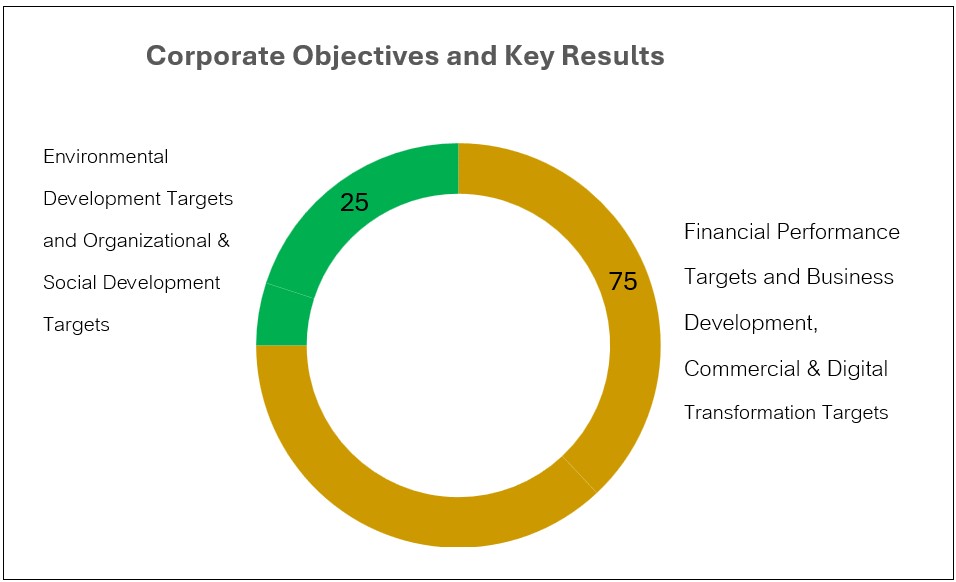
The company applies Agile management principles and an OKRs (Objectives and Key Results) framework alongside KPIs to define performance indicators for determining the compensation of the CEO, senior executives, and employees. A Balanced Scorecard framework is applied, with 75% weighted toward financial and business development targets, and 25% toward sustainability targets (environmental, organizational, and social). The performance components are as follows:
Financial Performance Indicators: Revenue Target, EBITDA, Net Profit After Tax (NPAT), Return on Invested Capital (ROIC), and share price growth relative to industry peers.
Business Development, Commercial & Digital Transformation Targets: Success in new project development per strategic plan, building commercial partnerships, customer and tenant satisfaction levels, and progress in Digital Adoption to deepen customer understanding and expand digital service channels.
Environmental Development Targets: Energy efficiency, greenhouse gas emission reductions, and resource management in pursuit of Net Zero goals.
Organizational and Social Development Targets: Talent development, Employee Engagement, occupational health and safety, and community support through business processes.
|
Compensation Structure
Fixed Remuneration - Comprising salary and benefits such as provident fund, medical coverage, accident insurance, travel insurance, and life insurance. Determined based on role, responsibilities, experience, skills, and leadership competencies, and reviewed annually against performance targets and plans, with reference to market benchmarks within the same industry to retain high-potential talent. This also includes support and assistance in cases of retirement, resignation, health issues, disability, or death.
Short-term Incentive - An annual cash bonus awarded based on actual performance achievements in the preceding year compared to targets (Pay for Performance), measured through Key Results (KRs) across multiple dimensions.
Long-term Incentive - Accumulated shares under an Employee Joint Investment Program, encouraging executives to develop a Sense of Ownership through a 5-year share accumulation scheme. The company contributes a matching rate of 100% of employee contributions (equivalent to 5% of monthly salary), incentivizing long-term organizational growth in alignment with shareholder interests.
Claw back Provision - The company operates under strict governance principles, with a clawback mechanism in place pursuant to Sections 89/18 and 89/19 of the Securities and Exchange Act, applicable in cases of dishonest conduct or misrepresentation of performance data, ensuring transparency and protecting the best interests of all stakeholders.
Process for Defining Sustainability Performance Indicators
The company has established a cascading process for translating sustainability indicators down to the operational level, driving organization-wide implementation in a concrete and structured manner:
Double Materiality Assessment (IRO Framework) - The company identifies and assesses material sustainability topics across three dimensions under the IRO principle - evaluating Impacts, Risks, and Opportunities:
Impact: Analyzing actual or potential impacts of the company's activities on the environment and society (Inside-out)
Risks & Opportunities: Analyzing financial risks and opportunities that external sustainability factors may pose to business value and stability (Outside-in), to prioritize and formulate sustainability strategies that genuinely address stakeholder needs
Indicator Cascading - Targets are cascaded in a structured hierarchy to relevant committees, working groups, and business units at the departmental, divisional, branch, and business group levels.
Weighting and Prioritization - To ensure assessments reflect the appropriate context, the company applies the following weighting principles:
Strategic Alignment: Weighting is assigned according to the significance of each IRO, balancing the management of negative impacts with the capture of business opportunities
Role-Based Relevance: Indicator weightings are adjusted to reflect each role's specific responsibilities and scope
Dynamic Adjustment: Weightings are reviewed using an Agile approach to remain responsive to shifts in material topics driven by evolving global conditions
Monitoring & Communication - Performance is monitored on an ongoing basis, with overall progress communicated to employees twice a year through Corporate Townhall meetings, ensuring organizational alignment on shared goals and readiness to effectively navigate emerging challenges.
Policy Document Link
https://sustainability.centralpattana.co.th/en/sustainability-at-cpn/sustainability-policy
Sustainability Goals & UN SDGs
Has Sustainability Goals
Yes
Goals Description
1. Strategy: Achieving net zero emissions and building local wealth
Material Sustainability Issues
1.1 Climate Change Adaptation
Indicator: E1 Reduction in greenhouse gas emissions (Scope 1, 2, and 3)
Short-term target (2025): 22.0% reduction compared to the 2019 base year
Medium-term target (2034): 46.2% reduction compared to the 2024 base year
Long-term target (2050): 90.0% reduction compared to the 2024 base year
1.2 Energy, Water, and Biodiversity Management
Indicators:
E2.1) Reduction in electricity consumption (controllable electricity use only) compared to 2024 (%)
Short-term target (2025): Reduce by 5%
Medium-term target (2034): Cumulative reduction of 35%
E2.2) Proportion of alternative energy compared to total energy consumption (%)
Short-term target (2025): Renewable electricity accounts for 4.5% of total electricity consumption
Medium-term target (2034): Renewable electricity accounts for 10% of total electricity consumption
E2.3) Reduction in water consumption compared to 2023 (%)
Short-term target (2025): Reduce by 5%
Medium-term target (2034): Cumulative reduction of 35%
E2.4) Wastewater quality meets legal regulatory standards
E2.5) Biodiversity loss is zero, or activities do not cause any loss of biodiversity
1.3 Waste and pollutants management and circular economy
Indicators ; Waste diversion rate (%)
• Short-term target 2025 : 60 %
• Medium-term target 2034 : 80 %
• Long-term target 2050 : 90 %
2. Strategy: Creating sustainable ecosystems through stakeholder collaboration
Material Sustainability Issues
S1: 2.1 Product stewardship and customer relations
Indicators ; Net Promotor Score (% NPS Score)
• Short-term target 2025 : 65 %
• Medium-term target 2030 : Top of mind brand
S2: 2.2 Tenant development and engagement
Indicators ; Net Promotor Score (% NPS Score)
• Short-term target 2025 : 49 %
• Medium-term target 2030 : Top of mind brand
S3: 2.3 Human capital management and labor practices
• Short-term target 2025 : Employee Engagement Score equal 80%
: 5% Improvement in Employee Productivity from 2023
S4 2.4 Occupational Health and Safety
• 'Zero' workplace fatalities among employees and contractors.
• 'Zero' severe workplace injuries among employees and contractors.
• 'Zero' cases of occupational diseases among employees and contractors.
S5 Society & Community Relations
Indicators :
1) Space allocated for community use against total leasable area (%)
• Short-term target 2025 : 1.3 %
• Medium-term target 2030 : 7 %
2) Local economic return from community-focused marketing activities (mn Baht)
• Short-term target 2025 : More than 2,780 mn Baht
• Long-term target 2050 : Community value impact of 1:20
S6 Human rights
Target : There are no significant disputes related to human rights violations.
3. Strategy ; Seizing new opportunities and mitigating sustainability risks and impacts
G1 Corporate Governance and risk and crisis management
Indicators:
1) Financial risk impact (%)
2) Complaints reports (cases)
Target : 100% complaint resolution rate
G2 Innovation Management
Indicators : Achievements of Power of Dream (Baht)
G3 Information and cyber security and data protection
Target : No breaches resulting in damaging consequences for the Company
G4 Supply chain management
Target :
1) The number of Significant Supplier Tier-1 and High ESG risk supplier that have undergone document-based assessments (Desk Assessments) or on-site partner assessments (On-Site Assessments) has reached 100%.
2) Local procurement accounts for 30% of total
UN Sustainable Development Goals
| SDG Goal |
|---|
| Goal 3 Good Health and Well-being |
| Goal 4 Quality Education |
| Goal 5 Gender Equality |
| Goal 6 Clean Water and Sanitation |
| Goal 7 Affordable and Clean Energy |
| Goal 8 Decent Work and Economic Growth |
| Goal 9 Industry, Innovation and Infrastructure |
| Goal 10 Reduce Inequalities |
| Goal 11 Sustainable Cities and Communities |
| Goal 12 Responsible Consumption and Production |
| Goal 13 Climate Action |
| Goal 17 Partnerships for the Goals |
Policy Review
Policy Reviewed This Year
Yes
Policy Changed This Year
Yes
Review Details
In 2025, Central Pattana Public Company Limited conducted a comprehensive review and improvement of its sustainability policies, upgrading from general principles in its Code of Conduct and corporate governance guidelines into specific, detailed, and actionable policies. This reflects the company's commitment to being a regional leader in sustainable real estate development.
Review and Improvement of Existing Policies
The company reviewed and updated 10 existing policies to align with current requirements and stakeholder expectations:
Anti-Corruption Measures — Strengthened prevention and audit mechanisms
No Gift Policy — Established clearer guidelines
Data Recording, Reporting, and Retention Policy — Updated for the digital era
Intellectual Property Policy — Enhanced IP protection for the digital economy
Legal Compliance and Human Rights Policy — Linked to UNGPs and ILO standards
Fair Competition Policy — Reinforced fair competition principles
Employee Treatment Policy — Added dimensions of diversity and development
Customer Treatment Policy — Emphasized experience and safety
Procurement and Supplier Relations Policy — Integrated ESG across the supply chain
Biodiversity Management Policy — Added Mitigation Hierarchy principles and FSC standards
Expanded Content in Existing Policies
The company expanded the scope and added details to 3 key policies:
11. Climate Protection Policy
Sets a clear Net Zero target by 2050
Applies Science Based Targets (SBT) methodology
Introduces Internal Carbon Pricing in investment decisions
Conducts Climate Scenario Analysis per TCFD standards
Establishes a Climate Change and Environment Committee (CEC)
12. Environmental Management Policy
Expanded into 6 core dimensions:
Climate management — Reduce greenhouse gases and increase renewable energy
Air quality management — Control VOCs and air pollutants
Energy management — Improve efficiency and clean energy use
Waste management — Systematically reduce and sort waste
Water management — Increase recycling and rainwater harvesting
Sustainable products and materials management — Select environmentally friendly materials
13. Information Security and Responsible AI Development Policy
Protects personal data to international standards
Develops AI ethically and transparently
Defends against cyber threats
Newly Created Policies — 3 New Policies
14. Waste Management Policy
Covers 2 main categories:
Construction Waste:
Sort before demolition
Repurpose and reuse materials
Reduce landfill disposal
Municipal Solid Waste:
Apply the 3Rs Framework (Reduce, Reuse, Recycle)
Classify into 4 types (paper, plastic, processed, landfill)
15. Responsible Product Stewardship Policy
Verify quality and safety of products and services
Take responsibility across the entire product lifecycle
Promote sustainable consumption
16. Sustainable Water Resource Management Policy
Increase the proportion of recycled water and rainwater harvesting
Develop wastewater treatment systems to meet standards
Set short- and long-term water reduction targets
Build community partnerships for natural water source conservation
Standardized Policy Structure
All policies are designed with a clear and comprehensive structure consisting of:
Scope — Defines target groups, coverage areas, and relevant stakeholders
Objectives — Clear, measurable goals aligned with organizational strategy
Organizational Responsibilities
Board of Directors — Approves and oversees
Senior Management — Allocates resources and coordinates
Risk Management Division — Assesses and monitors risks
Employees — Complies and reports violations
Management and Operational Scope — Specific practices, preventive and corrective measures, KPIs, covering the entire value chain from the organization to partners, communities, and stakeholders
Training — Awareness programs at all levels and necessary skill development
Complaints and Whistleblowing — Multiple reporting channels with whistleblower protection
Penalties — Clear disciplinary measures and fair investigation processes
Policy Review and Improvement — Reviewed at least once per year and updated to reflect changing circumstances
All reviewed and newly created policies are effective from May 2, 2025, reflecting the company's commitment to conducting business sustainably, transparently, and responsibly toward society and the environment — creating shared value with all stakeholders for a sustainable future for everyone.
Business Value Chain
Value Chain Description
Creating Sustainable Value
Business Value Chain
To ensure sustainable growth in real estate and mixed-use development, the company has integrated both positive and negative impact management principles into its end-to-end operations, structured across three main components:
Upstream Value Chain
Objective: Promote responsible procurement and enhance supplier capabilities to mitigate social and environmental risks at the source.
Sourcing & Construction — The supply chain is driven through a Green Procurement policy, emphasizing the use of low-carbon materials and construction waste management, alongside strict enforcement of human rights compliance and contractor safety standards.
Own Operations
Objective: Develop and manage environmentally friendly, safe, and highly efficient real estate projects throughout their operational lifecycle.
Land Acquisition & Investment — The company evaluates investment opportunities by assessing strategically located land with development potential, considering local demand, competitive intensity, and urban expansion trends. Climate change risk assessments (Physical & Transition Risks) and biodiversity conservation requirements are integrated into the process to avoid ecosystem disruption, deforestation, degradation of water sources, and harm to existing biodiversity. Land is acquired both directly and through licensed brokers, with purchase prices benchmarked against appraisal and market values, alongside thorough review of legal requirements and construction regulations.
Design & Development — The company is committed to elevating sustainable project development standards by integrating Green Building principles, Climate Adaptation, and Community Centric Design. Internationally and nationally recognized sustainability standards are applied in the design process, including LEED, TREES, and EDGE. In-depth natural disaster risk studies are conducted — such as 100-year return period rainfall analysis and drought scenario simulations — to design effective infrastructure and flood barrier systems. Solar rooftop installations are incorporated to promote clean energy use. All steps are carried out in strict compliance with legal requirements, including Social Impact Assessment (SIA) and Environmental Impact Assessment (EIA), with the highest priority given to natural resource conservation through proper tree relocation processes to preserve green areas sustainably. Architecturally, local cultural context and lifestyle are drawn upon to create distinctive buildings harmonious with their surroundings, while supporting the use of local materials to stimulate community economies and deliver shared commercial and social value.
Operations & Facility Management — The company strives to elevate service quality and facility management across its real estate portfolio to international standards, through technology ecosystem integration across three dimensions:
Smart Resource & Environmental Management: Deploying enterprise data management systems and AI (AI Chiller Plant) to optimize energy and water management, reduce operational costs, and advance waste management under Circular Economy principles through Recycle Stations, targeting Zero Waste to Landfill
Experience Delivery & Data Security: Enhancing security, cleanliness, and common area services, while implementing IT systems for customer database management with the highest priority given to Data Privacy
International Green & Wellness Building Standards: Maintaining certifications under ISO 14001 (Environmental Management), ISO 14064-1 (Greenhouse Gas Management), ISO 50001 (Energy Management), and Wellness Building standards
Downstream Value Chain
Objective: Deliver superior experiences to customers while driving shared economic growth with tenant partners and local communities.
Sales & Space Management — Properties are sold and leased through multiple channels, including direct sales offices and appointed specialist agents. For shopping centers and office buildings, the focus is on direct engagement with corporate clients and operators, with attention to diversified merchandising mix in retail spaces and modern work-style-aligned office space that promotes occupant well-being. For residential and hotel projects, online platforms and call centers are deployed to facilitate bookings and provide responsive customer information.
Marketing, Data Analytics & Community Placemaking — Advanced Data Analytics technology is leveraged through The 1 App partner platform and proprietary platforms to connect customer lifestyles across business segments, delivering Personalized Experiences across shopping, working, living, and hospitality. The company further focuses on Community Placemaking to support SMEs and elevate local products, while building tenant partnerships through Green Lease agreements covering both retail and office tenants. All product communications are conducted responsibly, transparently, and without exaggeration across all channels.
Customer Relationship Management (CRM) — A centralized customer service unit and specialized juristic person teams oversee all customer dimensions — from retail tenants and shoppers in malls, to corporate tenants and employees in offices, residents in housing and condominium projects, and hotel guests. Regular satisfaction surveys and feedback channels are maintained, with insights used to continuously improve operational efficiency and service quality. Customer engagement activities are organized to foster long-term loyalty and satisfaction.
Support Activities
Objective: To serve as the foundational enabler and ecosystem that supports all primary value chain activities to operate efficiently, transparently, and sustainably.
Human Resources Management — Recruitment, reskilling/upskilling, and employee well-being and Occupational Health & Safety (OHS) management, alongside promotion of Diversity, Equity & Inclusion (DEI), ensuring people remain a key driving force of the organization.
Risk Management & Governance — Integration of ESG risks (including climate change, regulatory, and cyber risks) into the enterprise risk management system, supported by internal controls, accounting, and transparent auditing processes.
Technology & Firm Infrastructure — Development of IT systems, enterprise resource management (SAP), and central infrastructure to drive full-scale Digital Transformation.
The 6 Capitals Integration
The company manages resources throughout its value chain in accordance with the 6 Capitals Integration framework, applying the Integrated Reporting Framework to reflect the organization's ability to transform inputs (fundamental resources) into tangible outputs and long-term positive impacts — financial, economic, social, and environmental — in a sustainable manner. Details of the company's value creation analysis across the 6 Capitals for 2025 are as follows.
Organizational Value Creation Overview Summary Table
The 6 Capitals | Inputs Foundational Resources | Outputs & Outcomes Tangible Performance Results (vs. Prior Year) | Impacts Long-term Value Delivered |
1. Financial Capital |
| To the Company
To Stakeholders
| Enterprise Value Impact
|
2. Manufactured Capital |
| To the Company
To Stakeholders
| Socio-economic Impact
|
3. Intellectual Capital | Tech & Data Ecosystem includes the The 1App database, Serve application, Central Offices, and SAP ERP system for enterprise-wide data integration. Standards & Know-how involves applying information security standards (ISO/IEC), an AI Chiller Plant management system, and expertise to obtain Green Building Certifications (e.g., LEED, TREES, EDGE). Tech & Data Ecosystem
| To the Company
| Enterprise Value Impact
|
4. Human Capital | The Company has a total workforce of 5,989 employees, with a budget of over THB 5,633 million allocated for employee care and capability development.Driving Reskill/Upskill initiatives and leadership development, alongside policies on Diversity, Equity & Inclusion (DEI) and workplace safety | To the Company
To Stakeholders
| Socio-Economic Impact Elevating professional standards for personnel in the retail and real estate industries, while fostering income security through quality employment. Enterprise Value Impact
|
5. Social & Relationship Capital |
| To the Company
To Stakeholders
| Socio-Economic Impact
Enterprise Value Impact
|
6. Natural Capital | The Company's consumption of electricity, water, fuel, and energy resources for business operations amounts to THB 2,595.8 million (-6%), while investing THB 600 million in rooftop solar energy systems, electricity-saving measures, and low-carbon materials. | To the Company
To the Environment & Stakeholders
| Environmental Impact Mitigating the effects of Climate Change Restoring natural resources and reducing pollution across the value chain |
Central Pattana's 2025 Performance and the Dynamics of Capital Transformation
Central Pattana's 2025 performance is the result of systematic resource management across all 6 Capitals, generating a "Dynamics of Capital Transformation" — an interconnected and mutually reinforcing cycle. For example, the allocation of Financial Capital (through green bonds) to develop Manufactured Capital (clean energy projects) reduces impacts on Natural Capital (greenhouse gas reduction) and strengthens Social Capital through enhanced stakeholder trust. Simultaneously, the development of Human Capital builds upon Intellectual Capital, which in turn supports tenant partner growth and feeds back into a stronger Financial Capital base. These mechanisms demonstrate that the management of intangible capitals is a critical driver of sustainable business returns and long-term growth.
Double Materiality Assessment
https://sustainability.centralpattana.co.th/th/sustainability-at-cpn/materiality-assessment
Central Pattana conducts an annual review and analysis of material sustainability topics relevant to both stakeholders and the business, applying the Double Materiality Principle — assessing the organization's impacts on the environment and society (Inside-out / Impact Materiality) and the effects of external ESG factors on financial standing and organizational value (Outside-in / Financial Materiality). This is conducted in alignment with GRI Standards 2021 and AA1000 V3, while also integrating IFRS S1 & S2 (ISSB) frameworks to more clearly articulate financial impacts, risks, and opportunities, with external verification under ISSA 5000 to ensure credibility and transparency.
The process consists of four key steps:
Step 1 - Identification & Screening
To capture topics reflective of evolving global and business dynamics, the company identifies issues through multiple input factors:
Value Chain & Context Analysis: Analyzing activities across the full value chain - from upstream to downstream - and across the business ecosystem (shopping centers, residential, office, and hotel), to identify linkages with key stakeholders (customers, partners, employees, communities), enterprise risks, and short-, medium-, and long-term strategic directions.
Six Capitals Risk & Opportunity Analysis: Assessing risk and opportunity drivers across Financial, Manufactured, Natural, Human, Intellectual, and Social Capitals to holistically reflect resource use and value creation.
Global Sustainability Trends & Standards: Referencing global trends from the World Economic Forum (WEF) and sustainability assessment institutions including Dow Jones Best-in-Class Indices, ISSB, and SASB, alongside stakeholder feedback.
All identified topics are reviewed against prior-year issues, updated as needed, and organized into topics and sub-topics.
Step 2 - Assessment & Prioritization
Material sustainability topics are evaluated through a Double Materiality Assessment across two dimensions:
Impact Materiality (Inside-Out): Assessing actual and potential positive and negative impacts on stakeholders and the environment, based on:
Severity of impact (scale of harm or benefit to people or the environment), referencing GRI Standards, SASB, ESRS, GRESB, and S&P Global (CSA), with stakeholder-weighted scoring applied where relevant
Scope of impact (breadth in terms of number of affected parties or geographic coverage)
Irremediable character (assessed for negative impacts only - the difficulty, timeframe, and feasibility of remediation)
The company has also begun applying Impact Valuation to quantify social and environmental impacts through economic monetization.
Financial Materiality (Outside-In): Evaluating risks and opportunities from external factors that may positively or negatively affect the company's financial position, cash flows, assets, and reputation across short, medium, and long terms — assessed against criteria of financial impact magnitude, likelihood of occurrence, cost-of-risk exposure, and the company's readiness to manage such impacts.
Step 3 - Prioritization & Validation
Identified topics are ranked and presented through a Materiality Matrix. Topics rated "Very High" significance are designated as core organizational KPIs and validated through:
Internal Review by the Sustainability Disclosure Taskforce, with approval from the Risk Management Committee and the Corporate Governance and Sustainable Development Committee
External Assurance by an independent external verifier, in accordance with AA1000AS V3 and ISSA 5000
Step 4 - Strategic Integration
The Sustainability Disclosure Taskforce publishes approved results on the company's website and integrates them into the strategic planning and enterprise risk management processes. Topics rated "Very High" (Key Material Topics) are translated into annual Sustainability OKRs and Key ESG Risk Indicators, directly linked to the performance evaluation and compensation (salary and bonus) of the CEO, senior executives, and all employees organization-wide.
2026 Annual Sustainability Strategy Review and Enhancement
The Board of Directors and the Sustainability Working Group approved a review of policies and long-term targets to align the governance structure with global context and international standards (IFRS S2 and TCFD), with the following key strategic enhancements:
1. Elevating to a Climate Transition Plan
The company has elevated its operational framework from a "Net Zero Pathway" to a more comprehensive "Climate Transition Plan", restructured across two key dimensions:
1.1 Climate Mitigation Strategy: Focusing on Core Measures to reduce Scope 1 & 2 carbon emissions through energy efficiency, and extending to Embodied Carbon reduction in Scope 3 across the supply chain. Carbon offsetting is repositioned as a last-resort measure applicable only to residual emissions that cannot be further reduced.
1.2 Climate Adaptation Strategy: A newly elevated dimension addressing the management of Physical Risks — such as flooding, storms, and heatwaves - by incorporating these factors into new project design criteria (Resilient Design) to build business resilience.
2. Restructuring of Material Issues
To reflect Dynamic Materiality, the company has restructured its material topics as follows:
2.1 Nature-Positive: Energy management is consolidated under greenhouse gas reduction (E1), while water management and biodiversity are separated into a dedicated topic (E4) to emphasize ecosystem stewardship.
2.2 Human-Centric: Air pollution and PM2.5 are expanded beyond the environmental dimension to also be reported under the social dimension — within Health & Well-being (S4) and Customer Experience (S1) — to directly reflect health impacts.
2.3 Innovation as an Enabler: Innovation is repositioned from a standalone topic to an embedded Intellectual Capital driver across all dimensions - environmental innovation (E1, G4), service innovation (S1, S2), and process innovation (S3) - demonstrating that innovation drives sustainability across the entire organization.
Summary of Changes in Sustainability Materiality Reporting, Status, and Strategic Significance: 2025–2026
Component | Key Shift | Strategic Status & Rationale |
1. Overall Framework | Net Zero Pathway -> Climate Transition Plan | Global Standard Alignment: Elevated to international standards, encompassing both Climate Mitigation and Climate Adaptation |
2. Operational Emission (Scope 1 & 2) | Decarbonization -> E1: Core Measures | Primary Driver : Core carbon reduction measures through Energy Efficiency and Renewable Energy |
3. Operational Emission (Scope 3: Embodied Carbon) | Decarbonization -> E1: Extended Measures | Value Chain Focus : Expanded to supply chain and environmentally conscious building design |
4. Carbon Offsetting | General Offset -> E1: Neutralization Measures | Last Resort: Offsetting Applied exclusively to Residual Emissions that cannot be further reduced, or for specific designated purposes only |
5. Climate Adaptation | (New Focus) -> E2: Elevated Dimension | Business Resilience: New dedicated topic to manage Physical Risks and build asset resilience |
6. Financial Mechanism | ROI -> ROI + ICP | Financial Impact Valuation Applied to assess Transition Risk valuation and Investment Opportunity valuation |
7. Governance | Standard Duties -> Climate Oversight Integration | Board Responsibility Board charters updated to explicitly define Climate Risk oversight responsibilities, with scope expanded to cover all business units |
8. Energy & Water/Bio | Separate Issues -> E1 & E4 Integration | Nature-Positive Energy management consolidated under E1 (GHG & Energy); water management and biodiversity separated as a dedicated topic under E4 to emphasize resource and ecosystem stewardship |
9. Pollution/PM2.5 | Environment -> Social Dimension | Human-Centric Reporting scope expanded to the social dimension to directly reflect human health impacts and customer experience |
10. Innovation | Standalone Issue -> Integrated Enabler | Intellectual Capital Repositioned as a cross-cutting "Enabler" embedded across all dimensions (E1, G4, S1, S2, S3) |
2025 Sustainability Materiality Assessment Results
https://sustainability.centralpattana.co.th/th/sustainability-at-cpn/materiality-assessment
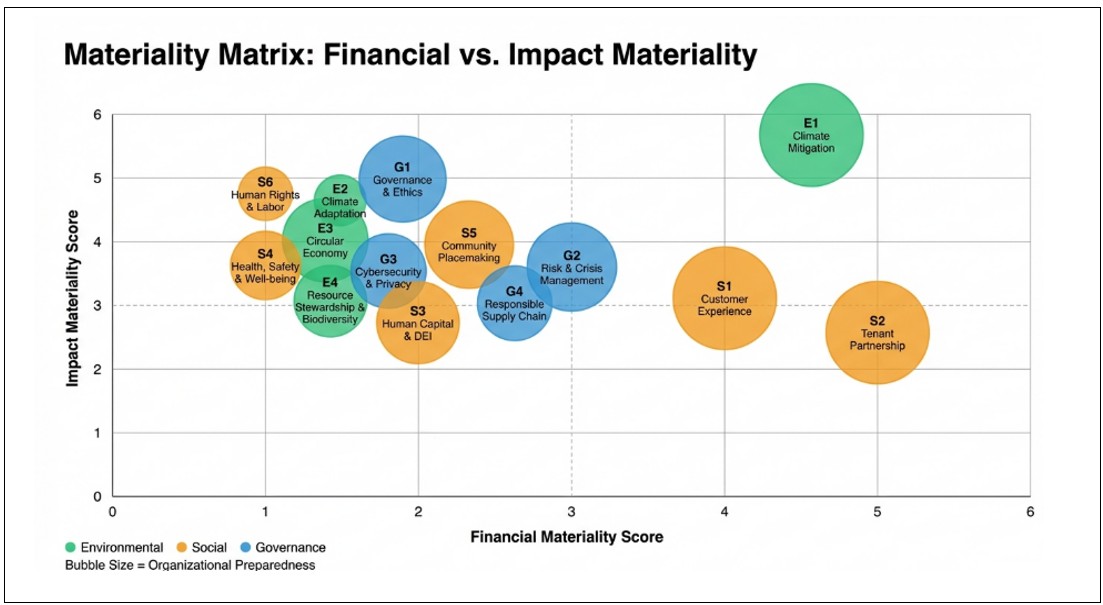
Following the four-step Double Materiality Assessment process and annual strategy review, the company has summarized its material sustainability topics through a Double Materiality Matrix, reflecting both Impact Materiality (environmental and social impacts) and Financial Materiality (impacts on business value), in alignment with IFRS S1, S2 and ESRS standards.
The assessment identifies 14 material sustainability topics as follows:
E1: Climate Mitigation
E2: Climate Adaptation
E3: Circular Economy
E4: Resource Stewardship & Biodiversity
S1: Customer Experience
S2: Tenant Partnership
S3: Human Capital & DEI
S4: Health, Safety & Well-being
S5: Community Placemaking
S6: Human Rights & Labor
G1: Governance & Ethics
G2: Risk & Crisis Management
G3: Cybersecurity & Privacy
G4: Responsible Supply Chain
Material Sustainability Topics Designated as Organizational KPIs
Material Topic / Action Plan | KPI | Short-term Target | Medium-term Target | Long-term Target |
E1: GHG Reduction | GHG Reduction
| 2025: Reduce by 22% vs. 2019 baseline 2026: Reduce by 10% vs. 2024 baseline | 2034: Reduce by 50% vs. 2024 baseline | 2050: Reduce by 90% vs. 2024 baseline |
E3: Circular Economy | Waste Diversion Rate | 2025: 60% of total waste volume | 2034: 80% of total waste volume | 2050: 90% of total waste volume |
S5: Community & Livable District Development Sustainable Community Development | Central Pattana | Proportion of community-allocated space vs. commercial common area | 2025: 2% or 14.2 million sqm-days | 2034: 7% | 2050: Under study for appropriate KPI |
Revenue returned to community through marketing activities and responsible procurement | 2025: THB 4,700 million | 2034: KPI adjusted to SROI at a ratio of 1:20 | 2050: Under study for appropriate KPI | |
G4: Responsible Supply Chain |
|
Double Materiality Matrix
Strategic Prioritization Analysis
Based on the analysis of the relationship between impact significance and organizational readiness, the company has grouped material topics into the following strategic management clusters:
Strategic Priorities — Top Right Quadrant Topics with high significance across both external impact and financial materiality dimensions:
E1 Climate Mitigation — Driving toward Net Zero
S1 Customer Experience — Through service innovation
S2 Tenant Partnership — For shared sustainable growth
Fundamental Priorities Governance and risk topics (G1–G4) and environmental topics serve as the critical foundation for building stakeholder confidence and ensuring business continuity. Also included are key stakeholder-related topics:
S5 Community & Livable District Development — An area of high organizational readiness, assessed as a future opportunity for sustainability value creation
S6 Human Rights & Labor — Assessed as a risk within the value chain
Enablers The company has integrated innovation as a supporting driver across all material topics, to elevate operational efficiency and enable the achievement of ambitious targets.
2025 Sustainability Performance & Value Creation Summary
Based on the materiality assessment results above, the company has defined strategic plans and management measures across each dimension — to transform risks into opportunities and generate positive economic, social, and environmental impacts (IRO & Impact Valuation), as detailed below:
Environmental Dimension (Better Planet)
Please share the content for this section and I will translate and format it accordingly.
|
Environmental Dimension (Better Planet)Driving toward Net Zero and ecosystem restoration — to reduce risks and create business opportunities
Material Topic | Context & Standards | IRO Analysis & Financial Valuation (Business Case & Valuation) | Key Actions |
E1: Climate Mitigation Scope: Throughout the value chain Impact Type: (-) Negative (Actual) (+) Positive (Potential) | Target: Net Zero 2050 Reference: IFRS S2, GRI 305 Related Capital: Natural Capital Financial Capital Manufactured Capital | Environmental & Social Impact Reducing global warming and energy costs Financial Impact Risk: Mitigating carbon tax risk and electricity cost volatility (THB 465 million) SROI: Social value generated from carbon reduction (THB 150 million) ROSI: Electricity cost savings and lower financing costs (THB 135 million) |
|
E2: Climate Adaptation Scope: Core Operations Impact Type: (-) Negative (Potential) (+) Positive (Actual) | Target: Business Continuity Reference: IFRS S2 (Physical Risk) Related Capital: Manufactured Capital Financial Capital | Environmental & Social Impact Creating safe spaces during disasters and reducing damage resulting from climate variability Financial Impact
| Applying Climate Scenario Analysis under the TCFD/IFRS S2 framework to assess physical risks over the next 10–20 years
|
E3: Circular Economy Scope: Core Operations and downstream Impact Type: (-) Negative (Actual) (+) Positive (Actual) | Target: Zero Waste to Landfill Reference: GRI 306 Related Capital: Natural Capital Manufactured Capital | Environmental & Social Impact Reducing landfill waste and creating business opportunities Financial Impact
|
|
E4: Resource & Biodiversity Scope: Upstream and Core Operations Impact Type: (-) Negative (Actual) (+) Positive (Potential) | Target: Nature Positive Reference: TNFD, GRI 303/304 Related Capital: Natural Capital Social & Relationship Capital | Environmental & Social Impact Restoring balance to the Urban Ecosystem Financial Impact
|
|
*Valuation conducted using the Benefit Transfer Method combined with Direct Market Price, encompassing environmental regulation value (ecosystem), resource management value (water management), and cultural, recreational, and leisure value - including air purification.
Social Dimension (Better People - Inclusive Growth & Well-being)
Elevating quality of life, reducing inequality, and growing together with communities.
Material Topic | Context & Standards | IRO Analysis & Financial Valuation (Business Case & Valuation) | Key Actions |
S1: Customer Experience Scope: Downstream Impact Type: (+) Positive (Actual) (-) Negative (Potential) | Target: Delivering beyond-expectation experiences Reference: SASB Related Capital: Social & Relationship Capital Intellectual Capital | Opportunities & Shared Value Creation Currently developing a financial impact valuation system for increasing Customer Lifetime Value (CLV) Financial Impact ROSI: Incremental revenue from customer satisfaction in The 1 Biz project, accounting for 70% |
|
S2: Tenant Partnership Scope: Downstream Impact Type: (+) Positive (Actual) (-) Negative (Potential) | Target: Co-growth & Green Lease Related Capital: Social & Relationship Capital Financial Capital | Opportunities & Shared Value Creation Generating stable income for tenants and reducing building vacancy rates Financial Impact (Calculated for the LEAD project only)
| Engaging tenants to achieve shared sustainability goals, such as expanding Green Lease agreements with retail tenants
|
S3: Human Capital & DEI Scope: Core Operation Impact Type: (+) Positive (Actual) (-) Negative (Potential) | Target: Developing personnel through a culture of mutual respect Reference: GRI 401/404/405 Related Capital: Human Capital Intellectual Capital | Risk: Mitigating Talent Shortage Financial Impact:
|
|
S4: Health & Safety Tenant Scope: Core Operation and Downstream Impact Type: (-) Negative (Potential) (+) Positive (Actual) | Target: Promoting well-being for tenants, residents, and visitors Reference: WELL, GRI 403 Related Capital: Human Capital Social & Relationship Capital | Opportunity: Attracting Customers and Tenants through Wellness Standards Financial Impact: Currently developing a system to itemize costs associated with delivering well-being for building users |
|
S5: Community Placemaking Scope: Throughout the value chain Impact Type: (+) Positive (Actual) | Target: Strengthening community economies Reference: GRI 413 Related Capital: Social & Relationship Capital Financial Capital | Positive Impact Generating local income and Social License Valuation
|
|
S6: Human Rights Scope: Throughout the value chain Impact Type: (-) Negative (Potential) (+) Positive (Actual) | Target: Zero tolerance for human rights violations throughout the value chain Reference: GRI 406-409 Related Capital: Human Capital Social & Relationship Capital | Risk: Preventing Work Stoppages and Legal Disputes Financial Impact: Preventing project disruptions from potential shutdown risk (THB 50.4 million per year) |
|
Better Governance -Trust & Resilience
Building Trust, Transparency, and Crisis Resilience
Material Topic | Context & Standards | IRO Analysis & Financial Valuation (Business Case & Valuation) | Key Actions |
G1: Governance & Ethics Scope: Throughout the value chain Impact Type: (-) Negative (Potential) (+) Positive (Actual) | Target: Conducting business with transparency and anti-corruption principles Reference: GRI 205 Related Capital: Social & Relationship Capital Financial Capital | Opportunity: Attracting Institutional Investors (Fund Flow) Financial Impact: Trust Premium on market capitalization (THB 5,600 million) * |
|
G2: Risk Management Scope: Throughout the value chain Impact Type: (-) Negative (Potential) | Target: Integrating sustainability risks into the enterprise risk management system Related Capital: Intellectual Capital Financial Capital | Impact: Building Resilience and Reducing Business Disruption Financial Impact: Prevented Business Interruption value |
|
G3: Cybersecurity & Privacy Scope: Core Operation and Downstream Impact Type: (-) Negative (Potential) | Target: Complying with the Personal Data Protection Act (PDPA) and building Data Trust Related Capital: Intellectual Capital Manufactured Capital | Risk: Protecting Against Reputational Damage and Legal Penalties Financial Impact: Currently under assessment for appropriate financial impact measurement |
|
G4: Responsible Supply Chain Scope: Upstream and Core Operation (Outsource) Impact Type: (-) Negative (Potential) (+) Positive (Actual) | Target: Implementing Green Procurement and conducting supplier sustainability assessments Reference: GRI 308, 414 Related Capital: Manufactured Capital Social & Relationship Capital | Impact: Mitigating Supply Chain Resource Scarcity Risk Financial Impact: Currently under assessment for appropriate financial impact measurement |
|
*Valuation based on the Research-Based Premium methodology, drawing from studies consistently indicating that investors are willing to pay a premium for shares of well-governed companies. The Company applies a 2% premium assumption.
Definitions
SROI (Social Return on Investment): An assessment of social and environmental impact that converts outcomes for communities and stakeholders into monetary value, demonstrating how much social value is generated per unit of investment.
ROSI (Return on Sustainability Investment): An assessment of the financial benefits returned to the organization from social or sustainability initiatives — such as cost reductions, revenue increases, or avoided risk values.
(+) Positive: Actual positive impact
(+) Positive: Potential positive impact
(-) Negative: Actual negative impact
(-) Negative: Potential negative impact
Stakeholder Analysis
Stakeholder Analysis
| Stakeholder Type | Stakeholders | Stakeholder Expectations | Response to Expectations | Communication Activities |
|---|---|---|---|---|
| External stakeholders | 2894 · Description: Creditor · 2898 · Description: Competitors · 2900 · Description: Business partners · 2902 · Description: Community · 2913 · Description: Shareholders · 2923 · Description: Customers · 2931 · Description: Government agencies and Regulators | 1. Customers
• Quality of service
• Convenience and safety in service usage
• Responsiveness to customer needs
• Speed and efficiency in data and information exchange
2. Suppliers / Contractors / Business Partners and Alliances
• Fairness, equality, and transparency in business operations
• Sustainable business collaboration approaches
• In-depth recommendations for innovation in joint business ventures
• Accurate and timely payment management
3. Community
• Consideration of community impact, including environmental, livelihood, and safety aspects
• Development initiatives for mutual benefits with the community
• Fair handling of complaints
• Collaboration for shared knowledge management
• Cooperation in environmental resource management
• Information exchange between parties
• Joint development of human resources
4. Investors / Shareholders
• Sustainable business growth
• Expectation for the company to operate under sustainable business practices
• Good corporate governance with transparency
• Risk management and business opportunity strategies
5. Creditors
• Good corporate governance and transparent management
• Risk management and business opportunity strategies
• Company credibility assessment
• Financial performance and future projects
• Debt repayment capability
6. Public & educational sectors, NGOs & other social entities
• Cooperation for knowledge management for common good
• Cooperation for environmental resource management
• Data exchange
• Joint development of personnel
7. Competitors
• Expectation for free & fair business competition
• Speedy of news distribution specifically safety and the latest announced law and regulations related to business operations | 1. Customers
• Delivering a superior and distinct experience
• Providing excellent, convenient, and safe services
• Developing personnel under the "Service with the Heart" program
• Building a business ecosystem
• Developing an Omni-channel approach
• Innovating continuously
2. Suppliers / Contractors / Business Partners and Alliances
• Ensuring fair and transparent competition
• Comparing at least 3 suppliers for each transaction
• Ensuring complete and timely payments
• Listening to feedback, offering suggestions, and assisting in problem resolution
• Collaborating on innovation
3. Community
• Engaging in community support initiatives
• Providing space for public and community benefit
• Participating in community volunteer activities
• Holding meetings to discuss and gather feedback, such as traffic management and waste management
• Opening facilities for field visits
• Signing collaboration agreements
• Supporting resources as needed in a proper manner
4. Investors / Shareholders
• Operating with transparency and good corporate governance
• Efficient management to build trust and maximize returns
• Providing transparent and comprehensive information consistently
• Complying with contracts, regulations, and laws
• Responding to sustainability assessments
5. Creditors
• Operating with transparency and good corporate governance
• Efficient management to build trust and maximize returns
• Paying debts in full and on time
6. Public & educational sectors, NGOs & other social entities
• Occasional consultation with public agencies
• Hearing views of experts and judges of SET
- Sustainability Excellence Awards
• Seeking and hearing comments from NGO administrators
• Consultation on waste management & greening with Bangkok Metropolitan
• Administration (BMA), provincial municipalities & business/social networks
• Opened sites for visit & shared knowledge with educational agencies
• MOU meeting with public sectors, educational institutes and independent organizations
• Participated in meetings with state agencies to develop prevention and remediation measures
7. Competitors
• Consultation for uniting business stance and approach toward public policies and legislation
• Communicating with specific group through social media such as LINE | 2938 · Description: Visit · 2939 · Description: Press Release · 2940 · Description: Social Event · 2941 · Description: Online Communication · 2943 · Description: External Meeting · 2944 · Description: Annual General Meeting (AGM) · 2945 · Description: Complaint Reception · 2947 · Description: Satisfaction Survey · 2948 · Description: Training / Seminar · 2949 · Other name: - · Description: Others |
| Internal stakeholders | 2906 · Description: Tenants · 2921 · Description: Employees | 1. Tenant Retailers, Office Tenants, and Residential Project Customers
• Delivery of buildings, facilities, spaces, and services with consistent quality and in a timely manner
• High service quality and efficient project management
• Convenience and a strong emphasis on safety
• Convenient and fast transactional channels between parties
• Creation of added value and shared value
2. Employees
• Competitive and fair compensation and benefits
• Job security and career advancement opportunities
• Development of skills, knowledge, and capabilities
• Well-being and quality of life
• Participation, open communication, and active listening
• Experiences beyond routine work
• Pride in being employees of the Company
• Cybersecurity and information security | 1. Tenants and Residential Project Customers
• Deliver high-quality products on time
• Provide excellent, convenient, and safe services
• Develop a business ecosystem that connects with related industries and stakeholders
• Foster innovation
• Develop specialized applications for targeted groups
• Take responsibility for products and services
• Address issues and implement improvements based on feedback
• Provide support and assistance during crises
Enhance capabilities through development and training programs
• Ensure timely and comprehensive communication of information and best practices
2. Employees
• Offer fair and competitive compensation aligned with market standards
• Develop a transparent performance evaluation and promotion system
• Organize lifestyle-based extracurricular activities
• Provide training programs aligned with career development plans
• Establish a Business Partner System to offer One-Stop Service assistance
• Listen to employee feedback, suggestions, and provide constructive responses | 2938 · Description: Visit · 2939 · Description: Press Release · 2940 · Description: Social Event · 2941 · Description: Online Communication · 2942 · Description: Internal Meeting · 2943 · Description: External Meeting · 2945 · Description: Complaint Reception · 2946 · Description: Employee Engagement Survey · 2947 · Description: Satisfaction Survey · 2948 · Description: Training / Seminar · 2949 · Other name: Customer Behavior Survey before Developing a New Project, Centralife X Application and SERVE Application, CNext Platform, Workplace, and MS Viva Connection, Information Counter · Description: Others |
Environmental Policy & Guidelines
Has an Environmental Policy
Yes
Policy Description
Environmental Management Approach
Central Pattana Public Company Limited operates its environmental management under its Climate and Environmental Policy,and overseen Environmental Management Policy by the Climate Change and Environment Committee (CEC), which operates under the supervision of the Corporate Governance and Sustainable Development Committee (CG-SD Committee). This governance structure drives the Company’s progress toward achieving its Net Zero target by 2050.
The Company systematically manages key environmental aspects, including energy, water, waste, biodiversity, and pollution, in accordance with international standards such as ISO 14001, ISO 14064-1, and ISO 50001, as well as climate adaptation frameworks.
1. Energy Management and Renewable Energy
The Company focuses on improving electricity efficiency across all operations while minimizing unnecessary energy consumption. Machinery and equipment are regularly maintained to ensure optimal performance, with continuous monitoring and improvement. Dedicated taskforces, such as the “Building Thermal Management Taskforce,” are established to enhance HVAC system efficiency.
International green building standards, such as LEED and WELL, are applied to reduce long-term environmental impacts.
The Company promotes the use of renewable energy across its operations and continuously increases the share of renewable energy consumption to support its low-carbon transition, while also exploring investments in environmentally friendly technologies.
2. Water Resource Management (sustainable-water-resources-management-policy.pdf)
The Company adopts a sustainable water management approach, focusing on efficient water use, reducing unnecessary consumption, and increasing the use of alternative water sources, including recycled and reused water (Recycle & Reuse) and rainwater harvesting.
Wastewater generated from operations is treated to meet regulatory standards prior to discharge into public water bodies, minimizing impacts on the environment and surrounding communities.
3. Waste Management (waste-management-policy.pdf)
The Company applies the principles of the circular economy by implementing the 3Rs: Reduce, Reuse, and Recycle, aiming to minimize waste generation at source. Waste segregation systems are implemented across all buildings, with proper waste management practices to reduce landfill disposal and maximize resource recovery.
4. Biodiversity Management (biodiversity-management-and-no-deforestation-policy.pdf)
The Company adopts a “No Net Loss” principle for biodiversity and avoids impacts on forest resources. Project development is restricted in environmentally sensitive areas, including World Heritage Sites and protected areas classified under IUCN Categories I–IV.
The Company follows the Mitigation Hierarchy (Avoid–Minimize–Restore–Offset) to systematically manage impacts on ecosystems. In addition, reforestation initiatives are implemented to increase green areas and enhance carbon sequestration.
5. Greenhouse Gas Management
The Company has set a target to achieve Net Zero greenhouse gas emissions by 2050, focusing on reducing emissions from both operational carbon and embodied carbon associated with materials and construction.
Continuous carbon reduction measures are implemented alongside climate risk management practices to ensure sustainable business growth in alignment with international standards.
6. Air Quality and Pollution Management
The Company controls indoor air quality to comply with applicable standards by selecting materials and equipment with low volatile organic compounds (VOCs) to minimize impacts on occupant health.
During construction, dust, noise, and vibration are monitored and controlled to reduce impacts on surrounding communities.
Policy Document Link
https://www.centralpattana.co.th/en/corporate-governance/policies-implementing-guidelines
Environmental Guidelines
| Guideline |
|---|
| Electricity Management |
| Fuel Management |
| Renewable/Clean Energy Management |
| Water Management |
| Waste Management |
| Biodiversity Management |
| Greenhouse Gas and Climate Change Management |
| Air Quality Management |
| Noise Pollution Management |
Environmental Policy Review
Policy Reviewed This Year
Yes
Review Details
Central Pattana has upgraded, expanded the scope, and updated practices from the original policies outlined in the Code of Conduct, which focused on general principles, into 5 specific policies emphasizing proactive strategies with clear details and measurable targets, effective from May 2, 2025.
The key changes are as follows:
1. Climate Change and Environmental Management Policy
Sets a clear Net Zero target by 2050
Applies Science Based Targets (SBT) methodology for greenhouse gas reduction goals
Introduces Internal Carbon Pricing in investment decision-making
Conducts Climate Scenario Analysis in accordance with TCFD standards
Establishes a Climate Change and Environment Committee (CEC) to drive the policy
2. Sustainable Water Resource Management Policy
Increases the proportion of recycled water and rainwater harvesting
Develops wastewater treatment systems to meet standards
Sets short- and long-term water reduction targets
Builds community partnerships for natural water source conservation
Covers the entire supply chain (contractors, tenants, and business partners)
3. Biodiversity Management and No-Deforestation Policy
Biodiversity:
Applies the Mitigation Hierarchy (Avoid > Minimize > Restore > Offset)
No projects in World Heritage sites or IUCN Category I–IV areas
Conducts ecological impact assessments before project commencement
Targets No Net Loss of biodiversity
Forestry:
Verifies the origin of materials; no use of illegal timber
Respects community rights under the Community Forest Act
Supports compensatory reforestation
Adheres to FSC (Forest Stewardship Council) principles
4. Environmental Management Policy
Pollution Management:
Controls air quality to meet standards
Reduces VOCs (Volatile Organic Compounds)
Maintains machinery to minimize pollution
Sustainable Construction:
Selects environmentally friendly materials
Reduces embodied carbon
Develops projects to Green Building / LEED / WELL standards
Integration:
Incorporates environmental policies as part of KPIs for executives and employees
5. Waste Management Policy
3Rs Framework:
Reduce: Minimize waste generation at the source
Reuse: Repurpose materials
Recycle: Sort and recycle
Specific Management Systems:
Disposal sites: Separated into general / hazardous / recyclable waste
Construction materials: Sorted prior to demolition; reused where possible
Processed and saleable materials: Categorized into 4 types (paper, plastic, processed, landfill)
Hazardous waste: Handled exclusively by licensed operators
Reduce landfill waste
Zero Food Waste campaign
Governance Structure Changes
All of the above policies include updates to the governance structure, with clearly defined roles and responsibilities across the organization, as follows:
Board of Directors - Approves and oversees
Climate Change and Environment Committee (CEC) - Drives the Net Zero agenda
Thermal Air Working Group - Manages energy efficiency
Risk Management Division - Assesses environmental risks
Policies & Guidelines Changed
| Change |
|---|
| Electricity Management |
| Fuel Management |
| Renewable/Clean Energy Management |
| Water Management |
| Waste Management |
| Biodiversity Management |
| Greenhouse Gas and Climate Change Management |
| Air Quality Management |
Energy — Plan & Guidelines
Has an Energy Management Plan
Yes
Plan Description
Energy Management approach
The Company is committed to strengthening energy security and enhancing operational cost efficiency (OPEX efficiency) through a systematic energy management framework. This approach covers both internal operations and the entire value chain, with key strategies outlined as follows:
1. Energy Governance
The Company manages energy in accordance with the Plan-Do-Check-Act (PDCA) cycle and complies with ISO 50001 standards. A Building Management System (BMS) serves as the core tool for monitoring and evaluating energy performance.
In addition, Site Energy Committees are established at the branch level to oversee, manage, and continuously improve energy performance in alignment with corporate targets.
2. Energy Sources
The Company manages two primary energy sources to diversify cost risks:
Non-renewable Energy: Electricity purchased from the grid and fossil fuels, such as diesel for backup generators and transportation
Renewable Energy: Electricity generated from rooftop solar photovoltaic systems, used to supplement energy demand and reduce peak load during daytime periods
3. Energy Boundary & Tenant Engagement
Energy management is categorized based on the level of control:
Common Areas and Central Cooling Systems (Company Control)
Managed directly by the Company through six engineering-based energy efficiency dimensionsTenant Areas (Tenant Control)
The Company promotes energy efficiency among tenants through the following initiatives:Implementation of Tenant Design Guidelines requiring energy-efficient equipment and alignment with green building standards
Installation of sub-metering systems to enable pay-per-use electricity consumption
Engagement programs such as Central Pattana Green Partnership and Energy Day activities
4. Energy Efficiency Measures
The Company implements energy efficiency measures across six engineering dimensions:
1) Building Envelope (Passive Design)
Focus on reducing heat transfer into buildings through architectural improvements, such as:
Installation of additional thermal insulation for roofs and walls
Use of active skylight systems and shading to control natural light and reduce heat gain
Integration of solar panels as shading elements on roofs and concrete surfaces
2) Hot Air Intake Management
Reduction of heat entering buildings and optimization of air balance systems by:
Deploying HVAC innovations such as Air Scrubber systems in fresh air intake
Reducing thermal load entering the building, improving overall cooling efficiency
3) Machine Efficiency
Enhancement of key equipment efficiency and adoption of innovative technologies, including:
Installation of high-efficiency chillers using low global warming potential (GWP) refrigerants
Upgrading cooling tower components and installing Variable Speed Drives (VSDs)
Replacement of motors with high-efficiency models
Pilot implementation of DC-powered air conditioning systems utilizing direct solar energy
4) Operation & Control
Optimization through automated systems and operational excellence across three dimensions:
Technology & Innovation:
Advancement from BMS to AI-driven Chiller Plant Optimization, leveraging real-time data from temperature and humidity sensorsProcess Optimization:
Implementation of AC control systems and operational adjustments aligned with thermal load patterns while maintaining thermal comfortPeople & Capability Development:
Training programs on environmental and energy management standards (e.g., ISO 14001, ISO 50001) to foster a culture of sustainability
5) Maintenance
Adoption of predictive and preventive maintenance using data from smart sensors and BMS to:
Ensure optimal equipment performance
Reduce equipment failure rates
6) Renewable Energy
Expansion of solar energy installations and integration as a standard requirement for new developments
5. Digitalization & Smart Platforms
The Company has developed a centralized environmental data management platform, initially focused on energy management, which:
Enables real-time performance monitoring for both site-level operators and central teams,
supports benchmarking against targets and enhances decision-making
Integrates AI and IoT technologies with chiller plant systems to improve precision and efficiency in energy reduction
6. Demand-side Management
The Company implements strategies to reduce peak electricity demand (peak load shaving) by optimizing the operation schedule of large equipment to avoid simultaneous usage.
This approach:
Reduces demand charges
Enhances grid resilience at the national level
Plan Document Link
https://sustainability.centralpattana.co.th/en/environmental/energy-management
Energy — Electricity Consumption
Electricity Consumption
| Metric | Current Year | Previous Year | Two Years Ago |
|---|---|---|---|
| Total electricity consumption within the organization (Kilowatt-Hours) | 601,189,000 | 604,857,000 | 559,903,000 |
| Electricity purchased for consumption from non-renewable energy sources (Kilowatt-Hours) | 559,709,000 | 566,908,000 | 533,892,000 |
| Electricity purchased or generated for consumption from renewable energy sources (Kilowatt-Hours) | 41,480,000 | 37,949,000 | 26,011,000 |
Energy — Fuel Consumption
Fuel Consumption
| Metric | Current Year | Previous Year | Two Years Ago | Remark |
|---|---|---|---|---|
| Jet fuel (Litres) | 0 | 0 | 0 | |
| Diesel (Litres) | 153,636 | 165,292.21 | 172,497.93 | |
| Gasoline (Litres) | 310,000 | 251,097.94 | 217,562.13 | |
| Fuel oil (Litres) | 0 | 0 | 0 | |
| Crude oil (Barrels) | 0 | 0 | 0 | |
| Natural gas (Standard cubic feet) | 0 | 0 | 0 | |
| LPG (Kilograms) | 11,184 | 13,856.49 | 12,159.23 | The data has been retroactively updated because last year it was recorded in 'liters'. |
| Steam (Metric tonnes) | 0 | 0 | 0 | |
| Coal (Metric tonnes) | 0 | 0 | 0 |
Energy — Targets
Has Set Targets
Yes
Targets
| Target | Base Year | Base Year Value | Target Year | Target Year Value | Target Change (%) | Unit | Per Unit (Intensity) | Per Unit — Please Specify |
|---|---|---|---|---|---|---|---|---|
| Increase of electricity consumption from renewable energy sources | 2,024 | 37,949 | 2,025 | 41,743.9 | 10 | Megawatt-Hours | ||
| Reduction of electricity purchased and fuel consumption | 2,024 | 608,925 | 2,025 | 30,446.25 | 5 | Megawatt-Hours | ||
| Reduction of electricity purchased for consumption | 2,015 | 172 | 2,025 | 137.6 | 20 | Kilowatt-hour | m2 | m2 |
Energy — Performance & Outcomes
Has Performance Results
Yes
Performance Description
The Company’s energy performance reflects the successful integration of engineering-based energy efficiency measures and smart technologies, enhancing energy efficiency, reducing operational costs, and delivering tangible contributions to the Company’s greenhouse gas (GHG) reduction targets.
1. Energy Efficiency Measures and Value Creation
The Company implemented a total of 66 energy efficiency measures, with a total investment of THB 92 million. These initiatives targeted electricity savings of 7,093 MWh per year, achieving 6,855 MWh per year, equivalent to 96.6% of the target.
Key measures include:
Building envelope improvement and hot air intake reduction:
Installation of insulation, window films, and skylight shading systems to reduce heat gainMachine efficiency enhancement:
Replacement with LED lighting, installation of high-efficiency chillers, upgrades of cooling water pumps (CDP & CHP), high-efficiency motors, and installation of Variable Speed Drives (VSDs)Operational efficiency improvement:
Optimization of chiller and pump system performanceRenewable energy integration:
Deployment of solar hybrid systems for air conditioning in elevator machine roomsSmart systems implementation:
Application of IoT, Building Management Systems (BMS), and photo sensors to optimize energy consumption
In addition, the Company strengthened employee capabilities through 31 energy-related training programs, with 1,816 participants (30.7%), fostering a long-term culture of energy efficiency.
2. Progress in Renewable Energy Generation
The Company established Central Pattana Green Growth Co., Ltd. (CPNGG), a wholly owned subsidiary, to develop and drive clean energy and environmental solutions.
In 2025:
Installed solar capacity increased to 35.84 MW, covering 31 shopping centers, 1 hotel, 3 office buildings, and 6 residential projects (clubhouse rooftops)
Total renewable electricity generation reached 40,158 MWh, representing a 358% increase from 2019, significantly reducing reliance on grid electricity and supporting GHG emission reductions
For 2026, the Company plans to:
Expand installations across new developments and 30 additional projects
Add 25.7 MW of capacity, bringing total installed capacity to 61.8 MW
3. Tenant Engagement Achievements
The Company has continued the Central Pattana Green Partnership program for the fourth consecutive year, driving tangible sustainability outcomes through energy audits and 3-year action plans with pilot tenants.
A GHG reduction guideline for tenants has been developed, with potential energy savings of up to 37,496 kWh per store.
In addition, the Company promotes waste management through the “Love the Earth” campaign at centralwOrld, with 3,249 participants. The initiative encourages environmentally responsible behavior through The 1 loyalty program, fostering a sustainability ecosystem among business partners and customers.
Energy-Efficient and Green Buildings
Central Pattana Public Company Limited places strong emphasis on the development of energy-efficient and green buildings across all dimensions. The Company is committed to sustainable design and construction standards to enhance energy efficiency, improve occupant well-being, reduce environmental impacts, and support long-term GHG reduction goals.
Projects are developed in alignment with both national and international green building standards, including TREES, LEED, and EDGE, with a focus on a lifecycle approach to minimize energy and resource consumption.
In 2025, the Company achieved a key milestone with Central Nakhon Sawan, which received TREES Gold certification from the Thai Green Building Institute—marking the Company’s first project certified under this standard. This success was driven by strategic collaboration with ONNEX by SCG, integrating green building design from the early development phase.
Subsequently, Central Chanthaburi also achieved TREES Gold certification, becoming the second project to do so. As of year-end 2025, 7.2% of the Company’s total portfolio (by floor area) has been certified as green buildings, with plans to expand certifications across new developments and renovation projects.
Energy Awards and Recognition
The Company continues to participate in energy performance assessments, including:
ASEAN Energy Awards (AEA)
Thailand Energy Awards (TEA)
MEA Energy Awards, under the Management of Energy Achievement (MEA Index)
Indoor Air Quality (IAQ) assessments
To date, the Company has received:
58 Thailand Energy Awards
12 ASEAN Energy Awards
20 MEA Energy Awards
In 2025, the Company received 3 additional Thailand Energy Awards for:
Central Samui
Central Eastville
Central Ubon
And, 3 additional MEA Energy Awards (Premium) for:
Central Chaengwattana
Central Rama 2
Central Rama 3
Overall, 82% of the Company’s total floor area has undergone energy performance assessments.
Water — Plan & Guidelines
Has a Water Management Plan
Yes
Plan Description
Water and Wastewater Management Approach
The Company is committed to managing water resources and wastewater efficiently and sustainably, aiming to balance project development, resource efficiency, and environmental stewardship. Water management strategies are integrated with the Company’s climate action roadmap, Net Zero 2050 target, and the Sustainable Development Goals (SDGs).
1. Risk Assessment and Governance
The Company discloses water consumption in accordance with GRI 303-1 and conducts water risk assessments across its operational areas. Key findings identify medium-to-high water risk areas, particularly within the Mekong and Chao Phraya river basins.
These risks are further analyzed alongside physical climate risks, including El Nino-related drought conditions, especially in the northern and northeastern regions.
To address these risks, the Company has developed systematic preparedness plans for droughts and floods, overseen by the Climate and Environmental Committee, which closely monitors implementation and performance.
2. Water Efficiency and Alternative Water Sources
The Company manages water demand across both indoor operations and landscape areas based on the 3Rs principle: Reduce, Reuse, and Recycle, alongside alternative water sourcing and systematic management approaches:
2.1 Water Reduction (Reduce)
Water consumption is minimized through advanced technologies and water-efficient equipment, including:
Installation of high-efficiency sanitary fixtures and sensor-based faucets in all restrooms
Optimization of water flow rates according to actual usage
Adoption of waterless cleaning technologies
Use of drip irrigation systems combined with water-efficient sprinklers for landscape management
Application of ozone technology in cooling tower water treatment to replace chemical usage, reduce scaling, minimize bleed-off, and decrease make-up water demand
2.2 Water Reuse (Reuse)
Implementation of systems to collect and reuse condensate water from cooling and air-conditioning systems for internal reuse
2.3 Water Recycling (Recycle)
Installation of water recycling systems within shopping centers to treat and reuse water for appropriate applications, such as sanitation and landscape irrigation
2.4 Alternative Water Sources
Promotion of alternative water usage through:
Rainwater harvesting systems for on-site utilization
Controlled use of groundwater, where legally permitted and licensed, to mitigate risks of water shortages
2.5 Systematic Water Efficiency Enhancement
System design and commissioning: Water systems are designed based on demand analysis, site suitability, and cost-effectiveness of recycling systems, with commissioning and periodic re-commissioning every two years
Leak detection and water monitoring systems: Installation of leak detection sensors integrated with pumping systems to enable rapid response and minimize water loss
Tenant engagement: 100% Installation of water metering systems in tenant areas to enable pay-per-use billing, creating incentives for efficient water use
3. Wastewater Management and Quality Control
The Company enforces strict wastewater discharge standards across all operations to prevent impacts on public water sources and surrounding communities:
Appropriate wastewater treatment technologies:
Utilization of technologies suited to site conditions, including Sequencing Batch Reactor (SBR) systems, Deep Shaft systems, and biological treatments for grease and odor removalWater quality monitoring in accordance with international standards:
Treated wastewater is tested monthly for parameters such as BOD, TSS, TDS, pH, and Oil & Grease by ISO/IEC 17025-certified external laboratories, with system management aligned with ISO 14001Emergency response measures:
In case of non-compliance, immediate corrective actions are taken, with escalation to site management and environmental committeesConstruction phase wastewater management:
Strict control of contractor wastewater management at worker camps, including training on organic waste segregation and the use of Effective Microorganisms (EM) for wastewater treatment and odor control.
4. Value Creation and Shared Value
The Company’s water management approach creates circular value and delivers benefits across multiple dimensions:
Economic Value: Reduction in municipal water consumption and improved wastewater efficiency, leading to long-term OPEX savings
Environmental Value: Reduced extraction of natural water resources and decreased GHG emissions associated with water production, treatment, and distribution (water-energy nexus)
Social Value: Mitigation of complaint risks, enhanced trust among customers and tenants, and protection of community access to clean water.
Water — Withdrawal, Discharge & Consumption
Water Withdrawal, Discharge & Consumption
| Metric | Current Year | Previous Year | Two Years Ago |
|---|---|---|---|
| Total water withdrawal (Cubic meters) | 13,156,140 | 12,916,695 | 11,820,100 |
| Total water withdrawal by third-party water (Cubic meters) | 12,909,341 | 12,688,337 | 11,605,870 |
| Total water withdrawal by surface water (Cubic meters) | 8,261 | 8,039 | 3,114 |
| Total water withdrawal by groundwater (Cubic meters) | 238,538 | 220,319 | 211,116 |
| Total water withdrawal by seawater (Cubic meters) | 0 | 0 | 0 |
| Total water withdrawal by produced water (Cubic meters) | 0 | 0 | 0 |
| Percentage of wastewater treated before discharge (%) | 99.63 | 99.63 | 99.64 |
| Total water discharge (Cubic meters) | 7,918,464 | 7,949,658 | 7,602,907 |
| Total water discharge to third-party water (Cubic meters) | 2,320,339 | 2,199,066 | 2,467,105 |
| Total water discharge to surface water (Cubic meters) | 5,598,125 | 5,750,592 | 5,135,802 |
| Total water discharge to groundwater (Cubic meters) | 0 | 0 | 0 |
| Total water discharge to seawater (Cubic meters) | 0 | 0 | 0 |
| Total water consumption (Cubic meters) | 5,237,676 | 4,967,037 | 4,217,193 |
| Recycled water (Cubic meters) | 408,616 | 596,762 | 617,371 |
Water — Targets
Has Set Targets
Yes
Targets
| Target | Base Year | Base Year Value | Target Year | Target Year Value | Target Change (%) | Unit |
|---|---|---|---|---|---|---|
| Reduction of water withdrawal | 2,024 | 12,916,695 | 2,025 | 645,834.75 | 5 | Cubic meters |
| Increase of recycled water for consumption | 2,024 | 596,762 | 2,025 | 29,838 | 5 | Cubic meters |
Water — Performance & Outcomes
Has Performance Results
Yes
Performance Description
The Company closely monitors and evaluates its water resource management to ensure alignment with long-term sustainability targets. Key achievements are as follows:
1. Performance in Water Recycling and Alternative Water Sources
Water Recycling Systems have been installed in 13 projects:
Total recycled water produced amounted to 408,616 cubic meters
This represents 3.1% of the Company’s total water consumption, and 15% of water consumption within projects equipped with recycling systems
Alternative Water Sources: The Company has implemented rainwater harvesting systems and utilized groundwater (where legally permitted) across 6 projects, including: Central Chiang Mai Airport, Central Chiang Rai, Central Chiang Mai, Central Samui, Central Phuket Floresta, and Central Udon.
2. Wastewater Management Standards and Regulatory Compliance
Wastewater Treatment and Discharge:
A total of 5.6 million cubic meters of wastewater was treated and safely discharged in compliance with regulatory standards
2.3 million cubic meters of wastewater was collected and transferred to licensed external specialists for further treatment
Environmental Complaints: The Company recorded zero environmental complaints related to wastewater management from communities and stakeholders, both during construction and operational phases.
Waste — Plan & Guidelines
Has a Waste Management Plan
Yes
Plan Description
Management Approach
The Company manages waste in strict compliance with applicable legal requirements, the Central Group’s waste segregation policy, the Climate and Environmental Policy, and the Social, Community, and Environmental Policy. Waste management is structured across the value chain in three key dimensions as follows:
1. Governance
The Company translates its climate and environmental policies from Board-level oversight into cross-functional implementation by appointing the Journey to Zero Working Team, comprising executives from the head office and representatives from all branches. The working team is responsible for formulating strategies and measures, as well as closely monitoring performance. It reports directly to the Climate and Environment Committee and the CSV (Creating Shared Value) Committee to ensure that waste management practices are aligned with the Company’s Net Zero by 2050 target and broader business objectives.
2. Value Chain Strategy
The Company recognizes the challenge of changing consumer behavior, as well as the relationship between waste volumes and financial impacts. From the tenants’ perspective, higher waste generation often correlates with increased customer traffic and higher revenues. In contrast, from the waste management perspective, greater waste volumes lead directly to higher disposal costs and regulatory expenses. The Company therefore transforms this challenge into an opportunity to create shared value through a “Waste-to-Value” approach and avoided cost management, with strategies implemented throughout the value chain as follows:
2.1 Upstream – Construction Waste Management
To raise waste management standards at construction sites in line with circular economy principles, the Company has established an operating framework under its Construction Waste Management Manual, covering processes from source segregation to end-of-life treatment. This framework is supported by financial incentive mechanisms and shared social value creation to encourage tangible contractor participation through the following three-step process:
1) Waste classification and segregation at source
Waste management requirements are incorporated into the scope of work and Terms of Reference (TOR), covering:
(1) demolition waste, (2) construction material waste, (3) waste generated by workers in labor camps, and (4) general solid waste.
Contractors are required to provide segregation bins for four waste categories: organic waste, recyclable waste, hazardous waste, and general waste. Educational communication materials on waste segregation must also be provided to workers, and monthly performance reports are required. These requirements are mandatory for new shopping center construction projects and renovation projects, covering more than 50% of the Company’s total new real estate development projects.
2) End-of-life management and resource circulation
Segregated waste is managed to recover as much value as possible through four approaches: sale, donation, sanitary landfill disposal, and processing/resource circulation across projects. The Company has demonstrated concrete outcomes in the following areas:
(1) Reuse
Structural and architectural works: For example, steel structures from dismantled parking roofs are repurposed into solar carport structures in parking buildings, while reusable materials in good condition, such as tiles, columns, walls, and flooring, are reused for decorative purposes.
Temporary facilities: For example, 40 containers have been circulated for use as site offices and worker accommodation, while temporary hoardings, metal sheet roofing, and transformers have also been reused across projects.
Earthworks: Soil excavated during construction has been transported for landfilling and leveling in other projects within the Group.
(2) Recycling
Construction material waste: Through the CECI network, gypsum boards have been segregated for recycling into new boards. More significantly, pile head concrete has been converted into Recycled Concrete Aggregate (RCA) for use as a substitute for crushed stone in temporary road construction. To date, approximately 10,000 tons have been processed, reducing greenhouse gas emissions by more than 900 tons of carbon dioxide equivalent.
Organic waste from workers: The Company promotes self-reliant circular waste practices in labor camps by converting leftover food and fruit and vegetable scraps into effective microorganisms (EM) solution for on-site wastewater treatment, compost, and vermiculture. The resulting compost is used in vegetable plots to support workers’ food welfare, while surplus produce is sold to generate income, which is then reinvested in food and school supplies for children in nearby communities.
(3) Upcycling and social value creation
Converting leftover materials for public benefit: Contractors are encouraged to cast leftover concrete from daily operations into paving slabs for improving the environment within labor camps, as well as for donation to temples and local communities for public use.
Project decoration: The Company procures loose furniture made from recycled waste materials for use in show units, clubhouses, and common areas.
Community-based incentives: Food scraps are used as animal feed, such as for raising ducks, and the eggs produced are used as rewards for workers who bring recyclable waste for exchange. This helps reduce landfill waste while improving workers’ quality of life.
3) Financial incentive mechanism
To maximize waste segregation efficiency and reduce landfill waste, the Company has established a policy under which all revenues and expenses related to waste management are considered the rights and benefits of contractors. This creates a positive incentive mechanism that encourages contractors to proactively generate value from waste through sale, processing, and welfare circulation, rather than disposing of it as mixed waste, which involves higher disposal costs.
2.2 Midstream – Operational and Internal Waste Management
The Company is committed to elevating operational standards toward excellence, beginning with the development of a strong internal culture and extending systematic waste management across shopping center operations through the following mechanisms:
1) Management structure and international standards
Journey to Zero Working Team: The Company has established a cross-functional team comprising members from the head office and representatives from all branches to jointly set targets, exchange best practices, and report performance outcomes to the Climate and Environment Committee.
ISO 14001 standard: The Company has strengthened its waste segregation and disposal processes by pursuing ISO 14001 Environmental Management System certification across shopping center areas nationwide to ensure that waste management processes meet international standards and are auditable.
2) Internal waste management
The Company instills an environmental mindset among employees through management of two main waste streams:
perational waste, such as repair works, demolition, marketing activities, and office equipment; and
municipal waste generated from employee consumption.
This is implemented based on the 3Rs principle through the following waste management strategies:
No-desk-bin Policy: Employee behavior is reshaped by replacing individual desk bins with centralized waste stations that separate waste into as many as nine categories: food waste, liquid waste, recyclable plastic bottles, recyclable paper, cardboard, recyclable aluminum cans and glass bottles, hazardous waste, electronic waste, refuse-derived fuel (RDF) waste, and general waste, in order to reduce contamination at source.
End-of-life management process: All waste is segregated for beneficial use through sale, donation, recycling, and processing, with landfill disposal minimized as much as possible.
Culture building and incentives: Ongoing e-learning and workshops are provided, alongside the “One Recycling Drop a Month” campaign held on the last Wednesday and Thursday of each month, encouraging employees to bring recyclables from home in exchange for The 1 points, together with branch-level competitions.
3) Recognition of greenhouse gas reduction achievements
The Company’s commitment to waste management has resulted in continued certification under the Low Emission Support Scheme (LESS)by the Thailand Greenhouse Gas Management Organization. Carbon reductions have been assessed and certified from three key activities: recyclable waste segregation, use of organic food waste as animal feed, and UHT carton segregation.
2.3 Downstream – Engagement with Customers, Partners, and Communities
Reducing waste at a national scale requires the collective efforts of all stakeholder groups. The Company therefore transforms its shopping centers into platforms for encouraging sustainable consumer behavior through collaborative initiatives with all sectors, as follows:
1) Infrastructure innovation for customers
Three-category waste sorting stations are provided for general waste, recyclable waste, and hazardous waste, along with dedicated collection bins for clear plastic bottles or PET bottles. These initiatives support the return of post-consumer recycled (PCR) plastics into the production cycle in line with circular economy principles.
Recycling drop-off points include Refund Machines that automatically collect PET bottles in exchange for The 1 points, as well as Ting Dee Boxes in shopping centers to collect clean plastics and cardboard.
Recycle Stations are operated in collaboration with the startup platform Recycle Day, providing permanent waste collection points and roadshow activities.
Green marketing campaigns are organized periodically, linking The 1 loyalty program and the Central X application to rewards and discount coupons, thereby encouraging customers to segregate waste on a sustained basis.
2) Collaboration with government agencies and sustainability networks
The Company has enhanced management of organic waste and hazardous waste by partnering with the Bangkok Metropolitan Administration (BMA) under the “Mai The Ruam” (No Mixed Waste) campaign to expand food waste segregation in shopping centers and office buildings, and with the Pollution Control Department to use shopping center spaces as community hazardous waste collection points.
To reduce plastic use, the Company collaborates with the PPP Plastic network through the “Tang Won Thung by Muewiset” project to collect flexible plastic waste, and participates in the Bottle Free Seas campaign to promote the use of personal water bottles and reduce single-use plastic bottle waste.
To create social value, the Company participates in the “Green Shelter – Collect Cartons to Build Homes” project with the Friends in Need (of “Pa”) Volunteers Foundation and Tetra Pak, recycling cleaned UHT cartons into construction materials for disaster relief beneficiaries.
3) Partnerships across the value chain
The Company collaborates with business partners to collect specific waste streams and channel them appropriately into the circular economy, for example:
Electronic waste (E-Waste): In collaboration with AIS, electronic waste bins are provided for safe disposal and recycling.
Clothing and textiles: In collaboration with Sabina under the “Where Do Old Bras Go?” campaign, collection boxes are provided for used underwear, which is then converted into clean energy.
Beverage packaging: In collaboration with Nestle under the “Give Plastic Bottles a New Life” project, the Company promotes segregation of drinking water bottles in food court areas.
3. Risk Management
The Company integrates waste management risk assessment into its Enterprise Risk Management (ERM) framework, with a focus on transition risks, including:
Regulatory risk: The Company closely monitors trends in local and national environmental regulations in order to proactively improve its operating systems.
Data management: The Company is developing a centralized waste data collection and analytics system to enable accurate monitoring of waste volumes, evaluation of waste reduction measures, and surveillance of risks that may affect surrounding communities in a transparent, verifiable, and reliable manner.
Waste — Generation, Disposal & Recycling
Waste Generation, Disposal & Recycling
| Metric | Current Year | Previous Year | Two Years Ago | Remark |
|---|---|---|---|---|
| Total waste generated (Kilograms) | 58,974 | 59,920.2 | 54,396.25 | |
| Non-hazardous waste (Kilograms) | 58,941.02 | 59,898.4 | 54,351.11 | |
| Non-hazardous waste - Landfilling (Kilograms) | 47,287.12 | 50,630.14 | 47,922.43 | |
| Non-hazardous waste - Incineration (with energy recovery) (Kilograms) | 11,634.11 | 9,229.8 | 6,398.26 | |
| Non-hazardous waste - Incineration (without energy recovery) (Kilograms) | 19.79 | 38.46 | 30.42 | |
| Non-hazardous waste - Other disposal operations (Kilograms) | ||||
| Hazardous waste (Kilograms) | 32.98 | 21.8 | 45.14 | |
| Hazardous waste - Landfilling (Kilograms) | 0.01 | 0 | 0 | |
| Hazardous waste - Incineration (with energy recovery) (Kilograms) | 0 | 0 | 0 | |
| Hazardous waste - Incineration (without energy recovery) (Kilograms) | 25.77 | 19.79 | 38.46 | |
| Hazardous waste - Other disposal operations (Kilograms) | 7.2 | 2.01 | 6.68 | Electronic waste that is recycled or returned to the manufacturer. |
| Total reused/recycled waste (Kilograms) | 43,733.07 | 32,243.29 | 22,157.17 | |
| Reused/Recycled non-hazardous waste (Kilograms) | 43,725.87 | 32,241.28 | 22,150.49 | |
| Reused non-hazardous waste (Kilograms) | 147.86 | 0.45 | ||
| Recycled non-hazardous waste (Kilograms) | 43,578.01 | 32,240.83 | 22,150.49 | |
| Reused/Recycled hazardous waste (Kilograms) | 7.2 | 2.01 | 6.68 | |
| Reused hazardous waste (Kilograms) | ||||
| Recycled hazardous waste (Kilograms) | 7.2 | 2.01 | 6.68 |
Waste — Targets
Has Set Targets
Yes
Targets
| Waste Type | Disposal Approach | Target | Target Year | Target Year Value | Target Change (%) | Unit |
|---|---|---|---|---|---|---|
| Non-hazardous waste | 2758 · Description: Reuse · 2759 · Description: Recycle · 2761 · Description: Incineration with energy recovery · 2763 · Description: Other | Increase waste utilization | 2,025 | 61,608 | 60 | Tonne |
Waste — Performance & Outcomes
Has Performance Results
Yes
Performance Description
1. Greenhouse Gas Reduction from Circular Economy (GHG Avoidance in Scope 3)
The total volume of operational waste generated from shopping centers and office buildings under Central Pattana and its subsidiaries amounted to 102,680 tons (including waste pending disposal as of year-end 2025), representing an 11% increase compared to 2024. Of this, 55,393 tons of waste were segregated, reflecting a 34% increase year-on-year. This resulted in a 54% reduction in landfill proportion relative to total waste disposed, equivalent to a diversion rate of 54%. This performance corresponds to 123,745 tons of carbon dioxide equivalent avoided. Compared to the previous year, total greenhouse gas emissions decreased by 6.8%.
Certification under the Low Emission Support Scheme (LESS) by the Thailand Greenhouse Gas Management Organization (TGO) confirmed that the Company achieved a total greenhouse gas reduction of 78,270 tCO2e from key activities, including recyclable waste segregation, use of food waste as animal feed, and UHT carton recycling, representing a 40.63% increase compared to 2024.
In addition, electronic waste (E-Waste) management contributed to an estimated reduction of 1,664 kgCO2e.
2. Value Recovery and Pollution Reduction
Electronic Waste (E-Waste):
A total of 7.2 tons of electronic waste was collected from tenants and waste segregation points across shopping centers nationwide and safely processed through certified disposal systems.Community Hazardous Waste:
The Company collected over 17.74 tons of hazardous waste from surrounding communities through designated collection points at shopping centers, ensuring proper and safe disposal.Single-use Plastic Avoidance:
Through the “Bottle Free Seas” initiative, the Company reduced single-use plastic bottle waste by more than 193,555 bottles during the year, with a cumulative total of 384,690 bottles avoided since project inception.
3. Expansion of Infrastructure and System Standards
ISO 14001 Certification Coverage: In 2025, the Company achieved ISO 14001 Environmental Management System certification across 39 shopping centers and 3 office buildings, representing 75% coverage of total operational areas.
Recycling Infrastructure for Communities:
Established 12 permanent Recycle Stations to facilitate waste segregation and recycling.
Designated 42 shopping centers nationwide as community hazardous waste collection points in collaboration with government agencies.
GHG — Plan & Guidelines
Has a GHG Management Plan
Yes
Plan Description
Climate Change Management
The Company drives climate action through its low-carbon strategy (Climate Mitigation: Journey to Net Zero), focusing on systematic greenhouse gas (GHG) management across Scope 1, Scope 2, and Scope 3 emissions. This approach enables value chain decarbonization while integrating climate-related considerations into corporate governance, business models, and financial planning in alignment with international disclosure standards, including IFRS S1 and IFRS S2. The Company aims to enhance long-term business resilience through the following framework:
1. Climate Risk Management & Strategic Planning
The Company integrates climate-related risks and opportunities into its Enterprise Risk Management (ERM) framework and strategic planning processes. Key actions include:
Climate Scenario Analysis:
The Company assesses both physical risks and transition risks across short-, medium-, and long-term horizons in alignment with TCFD and IFRS S2. Scenario analysis outcomes are incorporated into corporate strategy, asset management, and disaster risk insurance planning.Financial Impact Assessment:
The Company evaluates potential impacts on revenue, costs, and asset values arising from climate-related factors to support CAPEX/OPEX planning and investment decision-making in low-carbon initiatives.Capital Allocation & Green Financing:
The Company allocates capital toward low-carbon projects while leveraging sustainable finance instruments, such as Sustainability-Linked Loans (SLL) and Sustainability-Linked Bonds (SLB), to optimize financial costs and support the transition to a low-carbon economy.
2. Climate Transition Plan: Scope 1 & 2 Decarbonization
The Company implements a climate transition plan to reduce operational GHG emissions, with key measures including:
Energy Efficiency & Smart Technology (Smart Building & AI):
The Company enhances energy efficiency across shopping centers and office buildings through passive design, building thermal management, and the implementation of Building Management Systems (BMS). High-efficiency cooling systems (Smart HVAC), integrated with AI and IoT (AI Chiller Plant Optimization), are deployed to optimize performance based on real-time cooling demand.Clean Energy Transition:
As a founding member of RE100 Thailand Club, the Company accelerates the deployment of solar energy systems (Solar Rooftop and Solar Carport) across all operating sites. New developments are designed to integrate renewable energy from the construction phase, reducing reliance on fossil fuels and mitigating energy cost volatility.
3. Value Chain Decarbonization & Scope 3 Management
The Company expands its GHG management to cover the value chain in accordance with IFRS S2, focusing on key emission sources, including upstream construction materials and downstream tenant energy use. Key initiatives include:
Embodied Carbon Management:
The Company applies international green building standards, such as LEED, TREES, and EDGE, as well as GRESB-recognized frameworks, alongside a Green Procurement Policy to monitor and reduce emissions from key materials such as concrete and steel. Construction waste management is also implemented to mitigate future carbon pricing risks.Green Lease Policy:
The Company promotes tenant participation in decarbonization by establishing energy efficiency standards, including LED lighting, high-efficiency appliances, and sub-metering for electricity, water, and gas consumption. Waste segregation and management requirements are also enforced within tenant operations.Stakeholder Engagement (Green Partnership):
The Company collaborates with tenants, suppliers, and business partners under the “Know–Start–Reduce–Achieve” concept to enhance awareness and support GHG reduction strategies. This includes providing tools and guidance to improve energy efficiency and reduce emissions in tenant operations.Sustainable Infrastructure Development:
The Company partners with stakeholders to expand electric vehicle (EV) charging networks across shopping centers, office buildings, hotels, and residential projects, supporting the transition to low-carbon mobility.
4. Metrics, Targets & Carbon Offsetting
Metrics & Targets:
The Company has set a clear target to achieve Net Zero GHG emissions by 2050. GHG inventories are developed in accordance with ISO 14064-1, with preparations underway for sustainability data assurance under ISSA 5000 to enhance data credibility.SBTi Alignment:
The Company has developed an internal decarbonization pathway and a climate transition plan aligned with the 1.5C scenario, based on SBTi methodologies. The Board of Directors has approved maintaining a mid-term Scope 1 & 2 reduction target of 46.2%, representing the most ambitious level achievable under current supply chain constraints, while prudently managing financial risks (Strategic Deferral) pending further clarity on global real estate sector standards.Carbon Offsetting Strategy:
For residual emissions that cannot yet be avoided, the Company adopts a diversified offsetting approach, including:
Utility Green Tariff (renewable electricity procurement)
International Renewable Energy Certificates (I-RECs)
Verified carbon credits from recognized standards
Nature-based solutions, such as the “1 Million Trees” reforestation program
These measures support the achievement of the Company’s long-term climate targets in a sustainable and credible manner.
GHG — Emissions
GHG Emissions
| Metric | Current Year | Previous Year | Two Years Ago |
|---|---|---|---|
| Total GHG emissions (Metric tonnes of carbon dioxide equivalent) | 789,046 | 854,547 | 806,847 |
| Total greenhouse gas emissions 1 (Metric tonnes of carbon dioxide equivalent) | 6,658 | 3,715 | 4,779 |
| Total greenhouse gas emissions 2 (Metric tonnes of carbon dioxide equivalent) | 179,050 | 199,362 | 271,899 |
| Total greenhouse gas emissions 3 (Metric tonnes of carbon dioxide equivalent) | 603,338 | 651,470 | 530,169 |
GHG — Emissions Verification
Emissions Verified by a Third Party
Yes
Verifying Body
2647
Verification Document Link
https://eonemedia.setlink.set.or.th/report/0481/2025/1774062446758.pdf
Verification Web Page
https://sustainability.centralpattana.co.th/en/reporting-and-disclosure/assurance-statements
GHG — Principles & Standards
Principles & Standards Applied
| Standard |
|---|
| 2671 |
| 2672 |
| 2676 |
| 2677 |
GHG — Targets
Has Set GHG Targets
Yes
GHG Targets — Net Zero
Net Zero Targets
| Emission Scope | Base Year | Base Year Emissions | Near-term Target Year | Near-term Target Value | Near-term Target Change (%) | Long-term Target Year | Long-term Target Value | Long-term Target Change (%) | Target Year | Target Year Emissions | Target Change (%) | Unit |
|---|---|---|---|---|---|---|---|---|---|---|---|---|
| 2716 | 2,019 | 875,913 | 2,025 | 230,139.8 | 22 | 2,050 | 941,481 | 90 | 2,025 | 230,139.8 | 22 | Metric tonnes of carbon dioxide equivalent |
GHG — Performance & Outcomes
Has Performance Results
Yes
Performance Description
In 2025, Central Pattana Public Company Limited significantly advanced its greenhouse gas management practices in a tangible manner to progress toward becoming a low-carbon organization, driven through four key strategic pillars:
1. Climate Risk Management and Strategic Planning
The Company adopted Internal Carbon Pricing (ICP) as a decision-support tool for investment appraisal, establishing a shadow price of THB 200 per ton of carbon dioxide equivalent to support investment decisions and strengthen low-carbon investments.
The Company piloted the application of ICP in the “Central Krabi” project and allocated an additional Green CAPEX budget of THB 131.3 million to upgrade to high-efficiency technologies.
The Company established Central Pattana Green Growth (CPNGG), a wholly owned subsidiary of Central Pattana, to serve as a core vehicle for driving the Company’s Net Zero ambition through systematic investment in clean energy and sustainability solutions.
2. Transition Plan and Operational Decarbonization
Smart Technology Innovation:
The Company installed and integrated Building Management Systems (BMS) together with high-efficiency cooling system upgrades (Smart HVAC) incorporating AI and IoT technologies (AI Chiller Plant Optimization) at two sites, fully in line with the implementation plan. These initiatives reduced Scope 2 greenhouse gas emissions by 513.5 tCO2e per year and generated systemic returns under the Return on Sustainability Investment (ROSI) framework, as follows:Asset Optimization: Delivered electricity savings of 1,081 MWh, equivalent to THB 4.4 million in avoided operating costs (Avoided OPEX), while also enabling predictive maintenance that helps extend asset life.
Customer & Tenant Experience Enhancement: The system is able to maintain thermal comfort accurately in line with occupancy levels, contributing positively to customer satisfaction and supporting long-term rental yield retention.
Clean Energy Transition:
The Company continued expanding investment in solar power generation systems (Solar Rooftop and Solar Carport). As a result, in 2025, the total installed capacity reached 35.84 MW, generating 40,158 MWh of clean energy for self-consumption and reducing greenhouse gas emissions by 19,075 tCO2e. This investment:improved operational efficiency, reduced reliance on the main grid, and generated direct returns through avoided electricity costs of THB 163.04 million per year; and
served as a hedging mechanism against rising electricity tariff volatility (Ft) and reduced exposure to potential future government carbon tax measures.
3. Value Chain Resilience and Scope 3 Management
Green Procurement & Embodied Carbon:
To address upstream emissions, the Company advanced its Green Procurement Guideline into practical implementation by launching pilot projects in two new developments. The Company also worked proactively with international consultants and business partners to define specifications and select key construction materials with Environmental Product Declarations (EPD) and low-carbon labels, in order to reduce emissions from construction materials.Tenant Engagement:
The Company continued the Central Pattana Green Partnership program for the fourth consecutive year, providing tenants in three retail categories — food, fashion, and specialty stores — with a corporate carbon reduction strategy package, including guidance manuals and carbon footprint calculation tools. These measures can help achieve energy savings of up to 37,496 kWh per store.Circular Economy & Customer Engagement:
The Company promoted waste management through the “Love the Earth” campaign at centralwOrld, which attracted 3,249 participants. The campaign encouraged environmentally friendly behavior through The 1 loyalty points program, helping create a sustainability ecosystem in collaboration with business partners and customer communities.Sustainable Mobility:
The Company expanded its EV Charging Station network to cover 42 shopping centers, with a total of 545 charging bays, capable of serving more than 500,000 vehicles per year, thereby promoting and supporting the transition to clean mobility. The Company assessed the value of this investment under the Return on Sustainability Investment (ROSI) framework and found that it generated business value in two main dimensions:Direct returns / Green Revenue: Revenue from charging station and service area provision amounted to THB 7.65 million; and
Indirect returns and business growth: EV infrastructure helped attract higher-spending target customers and increased dwell time in shopping centers while vehicles were charging. This, in turn, supported tenant sales and generated tangible revenue circulation within the shopping center business ecosystem.
4. Metrics, Targets, and Carbon Offsetting
GHG Inventory:
Scope 1: 6,658 tCO2e
Scope 2 (Location-based): 179,050 tCO2e
Scope 3 (including key categories: Cat. 1, 3, 4, 5, 6, and 13): 603,306 tCO2e
GHG Intensity for Scope 1, 2, and 3: 182 kgCO2e per square meter
Impact Valuation:
The Company achieved reductions in Scope 1 and Scope 2 emissions compared with the base year, representing an avoided social cost of carbon valued at THB 30.2 million, thereby helping protect society from environmental and economic damages.Assurance and Verification:
The Company’s environmental data was externally assured by an independent third party in accordance with ISSA 5000 and GRI Standards.Science-based Alignment (SBTi Alignment):
The Company assessed and developed an internal decarbonization pathway based on the SBTi methodology. The Board of Directors resolved to maintain the 46.2% Scope 1 & 2 reduction target, representing the most ambitious target currently achievable within existing supply chain capabilities, while prudently managing financial risk through strategic deferral pending greater clarity on international real estate sector criteria.
5.Carbon Offsetting:
For residual emissions that cannot yet be avoided through available technologies, the Company has partnered with the Royal Forest Department, engaging specialists and local communities to plant and maintain forests under the “1 Million Trees Carbon Sink Reforestation Project” to offset corporate carbon emissions.
In 2025, a 500-rai area within Khlong Takhian National Reserved Forest, Chonburi Province, was registered under Thailand’s Voluntary Emission Reduction Program (Standard T-VER). The project is expected to sequester 475 tCO2e per year.
Environmental Legal Incidents
Legal Violation Incidents
| Metric | Current Year | Previous Year | Two Years Ago |
|---|---|---|---|
| Number of cases or incidents of legal violations or negative environmental impact (cases) | 0 | 0 | 0 |
Other Environmental Management
Plan Description
Air Quality and Pollution Management
The Company recognizes that air quality is a critical factor directly affecting the health and well-being of building occupants, as well as the quality of life of surrounding communities. The Company therefore places strong emphasis on managing environmental impacts across the entire project lifecycle—from design and construction to operational phases—by establishing policies, measures, and practices to control air pollution and prevent or mitigate potential impacts.
During the construction phase, which may generate impacts from dust arising from demolition, site preparation, and foundation works, as well as air emissions from machinery and intermittent noise disturbances, the Company implements preventive measures alongside continuous environmental monitoring. Key practices include:
Installing solid barriers with fire-retardant dust mesh sheets to prevent dust dispersion
Implementing wheel-washing systems for trucks prior to exiting construction sites
Regularly engaging with nearby residents to monitor and address construction-related impacts
Installing information boards with clear contact details of responsible personnel to facilitate communication and complaint handling
Planning construction activities to avoid simultaneous use of high-noise machinery
Cooperating with government authorities during periods of severe air pollution, such as adjusting or suspending construction activities during high PM2.5 episodes
Conducting continuous monitoring of dust, noise, and vibration within project sites and surrounding sensitive areas, with increased monitoring frequency during high-impact activities (e.g., daily monitoring of TSP, PM10, PM2.5, noise, and vibration during piling works), ensuring that all parameters remain within regulatory limits
During the operational phase, building activities do not result in significant direct air pollutant emissions. However, the Company continues to prioritize indoor air quality (IAQ) management to ensure a safe and healthy environment for occupants. Key measures include:
Selecting materials and equipment with low volatile organic compound (VOC) emissions to minimize impacts on health and the environment
Avoiding the use of fossil fuel-based machinery within buildings, except for emergency backup systems
In 2025, indoor air quality monitoring results across all projects indicated that key parameters—including PM2.5, PM10, CO, ozone, bacteria, fungi, and Legionella spp.—were in compliance with applicable standards.
Employees — Plan & Guidelines
Has an Employee Management Plan
Yes
Plan Description
Management Approach
1. Establish policies and implementing guidelines related to personnel including the Treatment of Employees Policy, Anti-Corruption Policy, Anti-Money Laundering Policy, Political Participation Policy, Responsibility for the Company’s Assets Policy and Respect for Law and Principles of Human Rights Policy. Our management practices align with the standards of the International Labour Organization (ILO), United Nations Global Compact (UNGC), and relevant national and international laws. At Central Pattana, our organizational culture is driven by four core beliefs and values rooted in sustainability principles, guiding us toward becoming an Employer of Choice.
2. As part of the Organizational Transformation plan, we have established a People Development strategy, leveraging digital technology to optimize people management processes and enhance the overall employee experience in recruitment, development, retention, performance
evaluation, communication and organizational culture building.
3. Respect the human rights of all employees by ensuring fair and equal treatment and supporting them to protect their rights. Employees can report any misconduct or inappropriate incidents through the Whistleblower system.
4. Utilize the Human Resource Information System, CneXt, to enhance workforce management by collecting and analyzing data, providing real-time insights and scenario forecasts for improved efficiency and faster processes.
5. Establish recruitment guidelines in line with the Human Rights Policy and develop workforce plan and Build & Buy
strategy, with workforce data analysis and forecasting through the CneXt system to support recruitment efforts via both internal channels within the company and Central Group as well as external sources.
6. Organize the employee development framework into three pathways: Functional Competency, Leadership Development and Talent and Succession, following the 70-20-10 learning model. Employees use the CneXt system to create personalized development plans and define their career goals.
7. Use the Objectives and Key Results (OKRs) framework to set goals and measure employee performance at all levels. The CneXt system integrates the performance evaluation process—from OKR goal-setting to salary reviews—and links performance data to career planning
and development.
8. Prioritize the well-being of employees by fostering positive relationships and creating a work environment that support their daily needs through the following:
8.1 Establishing workplace policies and welfare programs.
8.2 Setting up “Welfare Committees” to drive and promote employee welfare policies and “Occupational Safety, Health and Environment Committees” at both the corporate and branch levels to develop and implement workplace safety policies and plans.
8.3 Creating Workplace, a dedicated department to oversee and improve working conditions based on employee feedback.
8.4 Organizing employee engagement activities under the “YOU Dee Mee Sook: Well-being” framework, focusing on physical, mental financial and social well-being.
9. Strengthen organizational culture, which is underpinned by our four beliefs, to drive a culture of corporate governance, respect for human rights, risk management, under Governance, Risk Management & Internal Control and Compliance or GRC management approach and a
robust workplace safety culture.
10. Conduct the CG Voice employee engagement survey annually to gather feedback and understand employees’ needs which consists of (1) employee satisfaction and adhere to corporate purpose (2) work environment and job satisfaction (3) organizational culture (4) Happiness
and work stress management (5) Superior (6) Value and purpose of work - to continuously improve work processes. The results along with factors influencing employee engagement are analyzed and used to guide each unit’s management team in developing employee engagement action plans. OKRs are set for managers who have direct reports.
Treatment of employees policy
1. Central Pattana provides fair employment conditions so that employees may receive proper remunerations according to their knowledge, ability, potential, and performance, based on transparent and fair principles, in line with the Company’s performance and comparable to other companies in the same business.
2. Central Pattana suitably manages and develops its personnel’s knowledge, skills, experiences, and incentives.
3. Central Pattana provides a process of selection, appointment, transfer, welfare, awards, termination of employment, and punishment of employees, based on transparency, accountability, honesty, and fairness.
4. Central Pattana encourages employees to widely and continuously develop and exchange knowledge and ability.
5. Central Pattana is committed to oversee a working environment that is safe to health, life, and property of employees.
6. Central Pattana must provide key information to employees so that they may be aware of the Company’s performance and actual situations. 7. Central Pattana encourages dialogue between the Company and the employees or representatives of the employees to present information to the Company’s decision-makers so as to improve the quality of the workplace in view of joint development.
8. Central Pattana equally respects the rights of expression of all employees without intervention; also, sets up a process of hearings and complaints in a proper and fair manner.
9. Central Pattana promotes supporting activities so that employees may have a balanced life, whether related to work, education, recreation, or family.
Respect of law and principles of human rights policy
1. Central Pattana employees must thoroughly understand and strictly obey the law relating to one’s own duties and responsibility. If in doubt, seek advice from the legal department or a legal adviser. Avoid acting based on one’s own interpretation.
2. When working abroad, study the law, customs, traditions, and cultures of that country before undertaking any activity concerning the company’s business so as not to violate them.
3. Central Pattana promotes and respects the protection of human rights, and ensure that the Company’s business is in line with human rights concerning forced labor or child labor.
4. Central Pattana employees must respect and provide fair treatment to all stakeholders based on fairness, human dignity, non-discrimination of origin, race, gender, age, skin color, religion, physical state, status, or birth.
5. Central Pattana promotes compliance with human rights within the Company and encourages subsidiary companies, investors, business partners, and all stakeholders to observe the international standards of the principles of human rights.
6. Central Pattana protects the rights of stakeholders affected by the violation of their rights as a result of the Company’s operation by considering compensation no lower than the rate stipulated by law.
Safety and occupational health policy
1. Central Pattana must respect the law, rules, and other regulations concerning safety and occupational health in operating business.
2. Central Pattana arranges for sufficient, efficient practices and action plans on safety and occupational health.
3. Central Pattana arranges for sufficient, efficient, and proper security and alarm systems within the offices and factories under the Company’s management.
4. Central Pattana must prevent and control risk that may cause loss due to accidents, injuries, or illness from work, lost or damaged property, improper working methods, and other potential mistakes.
5. Central Pattana creates measures to strictly monitor the readiness of employees, business partners and affiliated entitle who involved in the operation. To reduce the risk which is caused by work or related to work.
6. Employees at all levels are responsible for monitoring and complying with the rules, regulation, standard and instruction on Safety and occupational health of themselves and teams. Supervisors must provide education and understanding among employees as well as ensure that the policy and guidelines of prevention and control guidelines are published, to prevent and control risk that may cause accidents. They shall foster the health of the employees according to their risk that they are responsibility to discharge.
7. Central Pattana sufficiently and efficiently arranges for public relations and communication to bring about understanding and disseminate information on safety and occupational health to employees as well as stakeholders.
8. Central Pattana continuously and regularly assesses and monitors work on safety and occupational health relating to business. Transparently report and disclose information on the process of safety and occupational health through appropriate channels and allow stakeholders to participate by commenting on issues which related to health and safety.
9. Central Pattana arranges for continuous and regular preparation in case of emergencies that may cause disruption to business operation or cause damage to the Company’s reputation and image.
Code of Conduct for Supplier
Labour Welfare & Human Rights
1. Fair and Equal Treatment
• Treat each person fairly based on their individual merit, respecting the principles of human rights, equality, and non-discrimination.This fairness should extend regardless of place of birth, origin, race, nationality, ethnicity, union status, gender, sexual orientation, age, skin color, religious belief, expression of views, physical disability, marital status or any other characteristic.
• Prevent any form of undue or sexual harassment of employees and other stakeholders, both physically and mentally
2. Labour Protection
• Refrain from hiring illegal underage labour and child labour.
• All employees must receive all protections as specified by law including developing and enhancing the proper quality of life and work protections.
• In hiring foreign labour, suppliers must observe all laws.
• Allocate suitable lodgings for labour on construction sites with due regard for safety and hygiene, while allocating separate lodgings for children away from such sites.
• Female employees must not be made to work in a manner that may jeopardize their health and safety. In the case of pregnancy, a supplier must provide employees with all protections and benefits as required by law.
• Refrain from depriving the freedom of association and collective bargaining rights of employees in accordance with the law.
3. Forced Labour
• Refrain from any forced labour that individuals have not entered into voluntarily. This includes human trafficking, which is the recruitment, transportation, transfer, harboring, or receipt of persons through threats, slave-like treatment of labour, debt bondage labour, physical and mental punishment in all forms.
• Labour can enjoy holidays or end employment as defined by law if justified and notified to suppliers
4. Wages, Benefits and Working conditions
• Allocate wages commensurate with knowledge, ability, and caliber, suiting employees merit and no lower than the standards prescribed by law. • Allocate work hours, overtime hours, and holidays as prescribed by law. Also, consider the physical conditions and mental demands that exist in the workplace.
• Overtime or holiday work must be voluntary.
Occupational Health & Safety
1. Safety Work Environment
• Strictly comply with all occupational health and safety laws.
• Promote and preserve the safety of employees and related parties by establishing and enhancing safety and hygiene in workplace.
• Put in place basic and adequate essential amenities and equipment to lower risks of accidents and health impacts arising from job performance, together with suitable first-aid equipment at the workplace.
• Provide monitoring and reporting systems on occupational health and safety in a transparent and ethical manner.
• Develop emergency plans for assorted work scenarios, including evacuation plans for labour/employees and training plans, and conduct regular drills.
• Promote a safety culture and provide training courses on risk assessment and risk control including safety standards and laws, for all employees and subcontractors.
2. Products & Services Quality and Safety
• Certify safety standards of products or services hired by the Company with primary regard for the safety of employees, customers, and related parties.
Plan Document Link
https://www.centralpattana.co.th/storage/sustainability/corporate-governance/code-of-business-conduct/20231122-cpn-code-conduct-cg-en.pdf#page=32
Page Number in Report
32, 29, 35
Plan Areas
| Plan Area |
|---|
| Fair employee compensation |
| Employee training and development |
| Promoting employee relations and participation |
| Migrant/foreign labor |
| Child labor |
| Occupational health and safety in workplace |
Employees — Workforce
Workforce Data
| Metric | Current Year | Previous Year | Two Years Ago |
|---|---|---|---|
| Total number of employees (Persons) | 5,989 | 6,141 | 5,648 |
| Number of male employees (Persons) | 2,984 | 3,085 | 2,813 |
| Number of female employees (Persons) | 3,005 | 3,056 | 2,835 |
| Total employment of disabled persons (people) | 28 | 22 | 17 |
| Total disabled employees (people) | 4 | 7 | 2 |
| Total male disabled employees (people) | 4 | 4 | 2 |
| Total female disabled employees (people) | 0 | 3 | 0 |
| Total disabled workers who are non-employee (people) | 24 | 15 | 15 |
| Contributions to the fund for promoting and improving the quality of life for disabled persons | 1 | 1 | 1 |
| Total number of male employees in operational level (Persons) | |||
| Total number of male employees in management level (Persons) | |||
| Total number of male employees in executive level (Persons) | |||
| Total number of female employees in operational level (Persons) | |||
| Total number of female employees in management level (Persons) | |||
| Total number of female employees in executive level (Persons) |
Employees — Remuneration & Provident Fund
Remuneration & Provident Fund
| Metric | Current Year | Previous Year | Two Years Ago |
|---|---|---|---|
| Total disabled employees (people) | 5,539,000,000 | 5,301,000,000 | 4,971,000,000 |
| Total male employee remuneration (Baht) | 2,682,000,000 | 2,659,000,000 | 2,416,000,000 |
| Total female employee remuneration (Baht) | 2,857,000,000 | 2,642,000,000 | 2,555,000,000 |
| Number of employees eligible to participate in PVD (persons) | 5,861 | 6,015 | 5,589 |
| Total number of employees joining employee provident fund (Persons) | 3,933 | 3,825 | 3,552 |
| Percentage of total number of employees joining employee provident fund to total number of employees (%) | 66.57 | 62 | 62 |
| Number of PVD members / Total eligible employees (%) | 68 | 63.59 | 63.55 |
| Total amount of provident fund contributed by the Company (Baht) | 120,744,988 | 109,897,877 | 99,834,662 |
| Total amount of provident fund contributed by employee (baht) | 174,288,976 | 155,840,101 | 136,277,846 |
Employees — Training & Development
Training Data
| Metric | Current Year | Previous Year | Two Years Ago |
|---|---|---|---|
| Average employee training hours (Hours / Person / Year) | 29 | 20 | 20 |
| Employee development and training expenses (baht) | 54,684,448 | 53,713,035 | 29,812,720 |
Employees — Occupational Health & Safety
Occupational Health & Safety Data
| Metric | Current Year | Previous Year | Two Years Ago |
|---|---|---|---|
| Total number of lost time injury incidents by employees (Cases) | 4 | 3 | 1 |
Employees — Labour Relations
Labour Relations Data
| Metric | Current Year | Previous Year | Two Years Ago |
|---|---|---|---|
| Total voluntary resignations (Persons) | 753 | 824 | 904 |
| Male employees who voluntary resigned (Persons) | 323 | 303 | 373 |
| Female employees who voluntary resigned (Persons) | 430 | 521 | 531 |
| Percentage of employee turnover leaving the Company voluntarily (%) | 12.57 | 13.42 | 16.01 |
| Evaluation result of employee engagement | 1 | 1 | 1 |
Employees — Employee Representation
Employees Are Represented Collectively
Yes
Forms of Representation
| Form | Other — Please Specify |
|---|---|
| Welfare committee | |
| Others | Occupational Safety and Health Committee |
Employees — Targets
Has Set Employee Targets
Yes
Targets
| Indicator | Target Areas | Base Year | Base Year — Description | Target Year | Target Year — Description |
|---|---|---|---|---|---|
| 1. CG Voice Rating 2. Human Capital Return on Investment (HCROI) | 2983 · Description: Fair employee compensation · 2984 · Description: Employee training and development · 2985 · Description: Promoting employee relations and participation · 2986 · Description: Migrant/foreign labor · 2988 · Description: Safety and occupational health at work · 2989 · Description: Non-discrimination · 2987 · Description: Child labor · 2990 · Other name: 1. Employee Engagement 2. Employee Productivity · Description: Others | 2,025 | Maintain or improve performance compared to the previous year. | 2,025 | 1. No Labor Disputes, including unfair employee compensation, illegal labor practices such as child labor, forced labor, illegal migrant labor, and workplace discrimination.
2. Employee Training and Development, All employees at every level have passed the learning assessment on the topic of corporate ethics and have undergone development according to the personnel development plan at 100%.
3. Maintain Employee Engagement at no less than 85%.
4. Occupational Health and Safety
4.1 Zero workplace fatalities among employees and contractors.
4.2 Zero severe workplace injuries among employees and contractors.
4.3 Zero cases of occupational diseases among employees and contractors.
5. Develop employee productivity by at least 5% per year |
Employees — Performance & Outcomes
Has Performance Results
Yes
Performance Description
Employee and Labor Management Performance & Outcomes
GRI 401-1 | GRI 404-1 | GRI 404-2
In 2025, Central Pattana managed and developed its workforce under the vision "Imagining Better Futures for All", guided by four core organizational values — Dynamism, Customers, Communities, and Collaboration — to foster a fair working environment, enhance employee potential, and support holistic well-being throughout every stage of the employee journey.
1. Fair Employment & Diversity
The Company upholds the principles of fair labor treatment and non-discrimination. In 2025, no disputes related to unfair employment practices were recorded. The Company maintains a 50:50 gender balance across all levels, including senior management, and ensures pay equity between genders at every level. The gender pay ratio (female-to-male) stands at 0.9 for senior executives, 1.04 for middle management, 1.05 for junior management, and 0.92 for operational staff — reflecting performance evaluations grounded in genuine competency, free from gender bias.
2. Capability Development & Training
The Company places strong emphasis on systematic and continuous people development. In 2025, 100% of employees received development under their Individual Development Plans and completed the Corporate Code of Conduct assessment, with an average of 29 training hours per person per year across 7 key areas:
Training Category | Coverage (persons) | % FTE | Key Courses |
|---|---|---|---|
Environment | 4,258 | 72.07% | Environmental & GHG management, waste sorting, green building standards, ISO 14001 |
Social | 1,863 | 31.53% | Human rights, competency & role-based skill development |
Governance | 166 | 2.81% | Workplace ethics, anti-corruption, grievance mechanisms |
Operational Quality Standards | 163 | 2.76% | ISO operational quality standards |
Occupational Health & Safety | 1,212 | 20.51% | Emergency response (fire evacuation, firefighting, chemical hazards, active shooter, disasters, earthquake), workplace safety, infectious disease prevention, LPG site operations, ISO 45001 |
Corporate Code of Conduct | 5,908 | 100% | Central Group Corporate Code of Conduct |
Digital Transformation | 5,197 | 87.97% | AI, Microsoft technology updates, phishing & cyber fraud awareness |
Key development programs include the Internal Trainer Program, which provides formal certification to in-house trainers, and the Power of Dream Program, which invites employees at all levels to propose innovations — generating an ROI of 5.3x in 2025. The Company also drives Reskill/Upskill initiatives in digital and sustainability competencies under an Agile & Flexible Working model, effectively aligning employee growth aspirations with organizational direction.
3. Employee Engagement & Well-being
The Company operates the "YOU DEE MEE SOOK" Well-being Program, providing comprehensive support across physical, mental, and financial dimensions. The program includes confidential psychiatric counseling, annual health check-ups, stress-relief activities such as massage, Yoga, Piloxing, and Zumba, cross-departmental Sports Clubs, and a Financial Wellness Program to support retirement readiness. A dedicated Employee Welfare Committee — separate from the Safety Committee, comprising 10 employee representatives has been established to channel employee needs into organizational policy decisions.
As a result, the Employee Engagement Index reached 88% in 2025, increasing 6.02% year-on-year and surpassing the target of 85%. Meanwhile, the voluntary turnover rate declined to 12.6% (down 6.11%), reflecting the effectiveness of building a workplace where employees feel trusted and motivated to grow alongside the organization.
4. Productivity & Organizational Performance
Employee Productivity in 2025 stood at 5.41, increasing 6.9% from 2024 — demonstrating that investment in people development and employee engagement translates directly into tangible business performance gains. The Company also promotes a culture of giving through the CPN Volunteer program, engaging over 700 employee volunteers per year to create shared value between the organization and its communities.
5. National & International Recognition
Central Pattana's achievements in human capital management were recognized across 6 prestigious awards at both national and international levels in 2025.
The Company was ranked No. 7 on the Best Workplaces Thailand 2025 list by Great Place to Work, with certification valid from May 2025 to May 2026 — reflecting a workplace culture where employees genuinely trust, take pride in, and feel cared for by their organization.
At the Future Trends Awards 2025 (national level), the Company received 3 awards: The Most Corporate Transformation, recognizing its people-centered approach to organizational change; and Most Attractive Employer for both workers under 35 and over 35, demonstrating the Company's ability to design meaningful work experiences that resonate across a multi-generational workforce.
At the Employee Experience Awards Thailand 2025 (Asia level), the Company received 2 Bronze awards: Best In-House Certification Programme for the Internal Trainer Program, and Best Soft Skill Training Programme for its leadership, teamwork, and communication development initiatives. Together, these awards affirm Central Pattana's commitment to being an employer of choice that creates lasting value for its people.
Customers — Plan & Guidelines
Has a Customer Management Plan
Yes
Plan Description
Guidelines for Information Security Management, Personal Data Protection, and Service Quality
1. Information Security and Personal Data Protection
1.1 Policy Framework and Reference Standards (GRI 418-1, IFRS S1 — Cybersecurity Risk)
The Company has established an information security policy covering all dimensions of operations, comprising an Information Security Policy, Privacy Policy, Cookie Policy, and Data Recording, Reporting, and Retention Policy. These policies are binding on all levels of employees and all stakeholder groups.
The information security management system operates under the ISO/IEC 27001:2013 standard and the NIST SP 800-53 framework, covering the entire organization's Hardware, Software, and Network infrastructure, in compliance with the Personal Data Protection Act B.E. 2562 (PDPA) and the Cybersecurity Act B.E. 2562.
1.2 Governance Structure (GRI 2-12, GRI 2-14)
The Company has established a clear and effective information security governance structure as follows:
Governance Level | Responsible Body | Reporting Frequency |
Board Level | Audit and Corporate Governance Committee | Quarterly |
Executive Level | Risk Management Committee | Quarterly |
Operational Level | Chief Information Security Officer (CISO) | Monthly |
Audit Level | Internal Audit Unit | Ongoing |
1.3 Personal Data Protection and Data Subject Rights (GRI 418-1, PDPA 2562)
The Company seeks consent for the collection, storage, use, and transfer of personal data in accordance with the principles of Data Minimization and Purpose Limitation. It has established comprehensive procedures to support the exercise of data subject rights as required by law, including a Data Breach Response Plan.
Complaint channels for personal data breaches are available through the Company's website (online complaint channel) or at whistleblower@centralpattana.co.th, and via the Customer Service Center at +66 (0) 2-667-5555.
All complaints are investigated by the Internal Audit unit and reported to the Audit and Corporate Governance Committee. The Company is prepared to provide appropriate compensation or remediation if the investigation finds that the breach resulted from the Company's own operations.
1.4 Cybersecurity Risk Preparedness and Management (IFRS S1 — Technology Risk, GRI 2-23)
The Company implements comprehensive cybersecurity risk management measures, including regular cybersecurity threat awareness training for employees at all levels, ongoing IT skills development for executives and the Board of Directors, the procurement of Cyber Insurance for risk transfer, and regular Business Continuity Plan (BCP) drills. In addition, the Company is in the process of preparing policies and procedures for the responsible adoption of Artificial Intelligence (AI Governance) in its business operations.
2. Service Quality and Customer Responsibility
(Primary Reference Standards: GRI 416, GRI 417, GRI 418, ISO/IEC 27001:2013, NIST SP 800-53, ISO 9001, PDPA B.E. 2562, IFRS S1)
2.1 Customer-Centric Operating Principles (GRI 417-1, GRI 417-2, ISO 9001)
The Company conducts its business under a customer treatment policy that spans all dimensions — from product design and service delivery to safety and systematic customer feedback — integrating the outcomes into sustainability considerations across social, environmental, and governance dimensions.
2.2 Project Quality and Safety Standards (GRI 416-1, GRI 416-2)
The Company adheres to rigorous quality and safety standards, encompassing: legally compliant construction permits for all projects; Environmental Impact Assessments (EIA) and Social Impact Assessments (SIA); green building, healthy building, and safety building certifications; and the development of service standards under the ISO 9001 framework to enhance customer satisfaction, reduce complaints, and prevent recurring issues.
2.3 Center of Life Strategy and Customer Value Delivery (GRI 413-1, GRI 417-3, SDG 11 — Sustainable Cities and Communities)
The Company develops and delivers spaces, products, and services under its Center of Life strategy to comprehensively serve all customer segments through diverse usage formats (Shop-Eat-Work-Play-Stay-Live), available 24 hours a day across the country. This is guided by a commitment to service that exceeds legally mandated standards, promotes equal access for all groups, and supports small entrepreneurs and community products through responsible marketing activities.
In 2025, the Company continues its commitment to elevating service quality and customer experience under the Center of Life strategy, which focuses on building a comprehensive life ecosystem. This encompasses both in-mall services and facilities and transportation access and parking, in response to evolving consumer behavior in the digital era — including high-rise and condominium living lifestyles, the shift to online shopping, and the challenges of technological innovation.
The Company upholds "Service with the Heart" as its core service philosophy, encouraging employees at all levels to develop a genuine service mindset with attention to detail and authentic responsiveness to customer needs. This is paired with continuous customer listening through annual Customer Satisfaction Surveys and Net Promoter Score (NPS) measurements across common areas and various services.
The Company develops products and services across multiple dimensions to serve all customer groups under the 8 Destination concept: Family Destination, Food Destination, Fashion Destination, Lifestyle Destination, Pet Destination, Sport Destination, Tourist Destination, and Community Hub. Each dimension is designed to align with the diverse needs of modern consumers — from families and food lovers to tourists, pet owners, and sports enthusiasts.
2.3.1 In-Mall Services and Facilities
The Company places strong emphasis on developing services and facilities within its shopping centers to serve all customer groups, taking into account the diversity of users — from families with children and elderly visitors, to people requiring special assistance, to both Thai and international tourists — while incorporating innovation and technology to elevate the experience in every dimension. In 2025, the Company's services span 44 shopping centers nationwide, up from 42 in the previous year, reflecting continuous expansion and improvement of service standards. Details of the services and facilities provided are as follows:
For Families and Those Requiring Special Care
The Company provides comprehensive family-oriented facilities, including Mom & Baby Rooms, Baby Changing Rooms, wall-mounted Baby Changing Stations and dedicated children's restrooms.
For mobility within the mall, the Company offers Baby Strollers, Kiddy Cars and Happy Train vehicles. Additionally, there are Playgrounds and Kids Corners in Food Court areas, enriching the experience for children and families.
For customers requiring special assistance, the Company provides Wheelchairs, Handicap Restrooms, Ambassador staff to assist special-needs customers. There are also pet strollers, reflecting a tangible commitment to pet-loving customers.
For Tourists
The Company offers a range of services for both Thai and international tourists, including group tour counters, Tourist Information Centers, Bag Deposit & Luggage Delivery points, and Lost & Found service points, all designed to maximize convenience for visiting tourists.
For General Visitors
The Company provides Rest Area zones and Rest Hub workspaces with charging points, catering to customers who need a workspace outside the home or simply wish to rest between shopping.
On the technology convenience front, the Company offers Power Bank rental units, tourist WiFi, mobile phone charging lockers, and Mobile Applications for customers.
The Company also places great importance on safety and public welfare services, providing First Aid Rooms, Automated External Defibrillators (AEDs), prayer rooms, G Service Points (government service centers), and Drive & Drop Recycle Stations, promoting sustainable development alongside service excellence.
3. Respect for and Protection of Intellectual Property
(Additional Reference Standards: Copyright Act B.E. 2537, Trademark Act B.E. 2534, Patent Act B.E. 2522, TRIPS Agreement (WTO), ISO/IEC 27001 Annex A.8)
3.1 Policy Framework (GRI 2-23, TRIPS Agreement)
The Company has established intellectual property guidelines as part of its Business Code of Conduct and Asset Responsibility Policy, covering both the protection of intellectual property owned by the Company and the respect for third-party intellectual property rights, in compliance with Thai intellectual property law and the WTO's TRIPS Agreement.
3.2 Protection of Organizational Intellectual Property
The Company registers and manages the rights to intellectual property it has created, covering trademarks, copyrights, patents, and trade secrets, in order to preserve organizational value and competitive advantage. It also ensures that intellectual works created by employees on behalf of the organization are appropriately protected under the relevant legal framework.
3.3 Respect for Others' Intellectual Property
All employees, partners, and contractors working with the Company must strictly comply with intellectual property laws — particularly regarding Software License Compliance — and are prohibited from using copyrighted content, works, or data without authorization. This is directly linked to the ISO/IEC 27001 information security standard with respect to information asset management.
3.4 Innovation and Knowledge Management (GRI 2-23, IFRS S1 — Innovation & Technology Risk)
The Company promotes the systematic creation, storage, and sharing of organizational knowledge to drive innovation and elevate product and service quality. Clear guidelines have been established for the responsible use of Artificial Intelligence (AI) to prevent intellectual property infringement risks that may arise from the use of AI in business processes.
Tenant and Retailer Management
Building a Co-Growing Retail Economic Ecosystem
GRI 2-6 | Activities, value chain and other business relationships GRI 2-22 | Statement on sustainable development strategy
Central Pattana places the highest importance on customers, retailers, and business partners as essential components of the economic ecosystem it has built through its nationwide network of shopping centers and mixed-use developments. As a leading shopping center developer and operator, the Company recognizes that organizational success is not measured solely by financial performance, but equally by the success of tenant businesses, the satisfaction of visitors, and the growth of local economies.
Central shopping centers across Thailand welcome an average of more than 1.3 million visits per day — or nearly 500 million visits per year — establishing these spaces as true Centers of Life for communities in every city and serving as a vital engine for local economic activity. The Company views its shopping centers as more than retail destinations; they are Retail Ecosystem Platforms that connect consumers, entrepreneurs, and communities.
To this end, the Company manages its tenants and retailers under the "Tenant Centric Business Partnership" philosophy, which prioritizes building long-term collaborative relationships with operators to support stable and sustainable business growth. This approach encompasses four core dimensions:
Developing entrepreneurial knowledge and capability through the LEAD Program
Building digital platforms to enhance retail management efficiency
Creating joint marketing campaigns with tenants to drive sales throughout the year
Supporting tenants in sustainable business practices through the Green Partnership Program
SDG Alignment — Tenant Management
GRI 203-1 | Infrastructure investments and services supported GRI 413-1 | Operations with local community engagement GRI SDG 8.3 / 8.6 | Decent Work and Economic Growth
The Company systematically integrates tenant and retailer management with the UN Sustainable Development Goals (SDGs), creating shared value for the organization, entrepreneurs, and society at large. As a large-scale shopping center developer and operator, the Company plays a pivotal role in providing an economic platform for Thai entrepreneurs, supporting the growth of retail and service businesses across all scales, from local operators and SMEs to international brands. The Company also promotes environmental collaboration with tenants through the Green Partnership Program, targeting energy reduction, GHG emission reduction, and environmentally responsible business practices.
SDG | Goal | Alignment with Tenant Management |
|---|---|---|
SDG 8 | Decent Work & Economic Growth | The LEAD Program has created opportunities for Thai SMEs — accumulating 240 brands, generating over THB 3,800 million in economic value, and expanding to more than 600 storefronts |
SDG 9 | Innovation & Infrastructure | The SERVE Platform, Smart Property Management, and E-Tax System elevate digital retail management efficiency |
SDG 10 | Reduced Inequalities | Opening opportunities for operators of all sizes — local and international, small and large — to access retail space and knowledge on equal terms |
SDG 11 | Sustainable Cities & Communities | Developing shopping centers as Centers of Life, promoting local economies through nearly 500 million visits per year |
SDG 12 | Responsible Consumption & Production | Green Partnership jointly reduces GHG emissions with tenants, with energy usage reporting available through the SERVE App |
SDG 17 | Partnerships for the Goals | A collaborative network connecting the Company, tenants, financial institutions (UOB), and academic institutions |
Targets & Performance Results
GRI 2-22 | Statement on sustainable development strategy GRI 306-4 | Disclosure on product and service quality management
The Company places strong emphasis on continuously monitoring and evaluating service quality performance, customer satisfaction, and complaint management efficiency — ensuring that the experiences of tenants and visitors are systematically enhanced. Key performance indicators include Net Promoter Score (NPS), CSAT, Complaint Management, and Tenant Engagement.
Plan Areas
| Plan Area | Other — Please Specify |
|---|---|
| Responsible production and services for customers | |
| Communication of product and service impacts to customers/consumers | |
| Development of customer satisfaction and customer relationship | |
| Protection of customer personal information | |
| Others | Respect for Intellectual Property |
Customers — Satisfaction Results
Customer Satisfaction Results
| Metric | Current Year | Previous Year | Two Years Ago |
|---|---|---|---|
| Evaluation results of customer satisfaction | 1 | 1 | 1 |
Customers — Targets
Has Set Customer Targets
Yes
Targets
| Indicator | Target Areas | Target Year | Target Year — Description |
|---|---|---|---|
| 1. Complaints regarding customer privacy violations, including data leaks and data loss. 2. Complaints regarding the impact of privacy violations on stakeholders. 3. Complaint Resolution Efficiency | 3010 · Description: Consumer data privacy and protection | 2,025 | 1. No complaints regarding customer privacy violations, data leaks, or data loss.
2. No complaints regarding the impact of privacy violations on stakeholders.
3. 100% of customer complaints resolved within the specified timeframe |
| Net Promoter Score (NPS) | 3009 · Description: Development of customer satisfaction and customer relationship | 2,025 | - Overall Customer Satisfaction Score (NPS) of not less than 65%
- Overall Tenant Satisfaction Score (NPS) of not less than 49% |
Customers — Performance & Outcomes
Has Performance Results
Yes
Performance Description
Customer Management Targets
Information Security & Personal Data Protection
The Company sets a target of zero confirmed personal data breach incidents and zero substantiated privacy complaints annually, operating under the ISO/IEC 27001 framework, NIST SP 800-53, and the Personal Data Protection Act B.E. 2562 (PDPA).
Service Quality & Customer Accountability
The Company is committed to delivering quality experiences and services to all customer segments under the Center of Life strategy, guided by principles of safety, fairness, and universal accessibility — while continuously developing service standards under the ISO 9001 framework to reduce complaints and sustainably enhance customer satisfaction.
Respect & Protection of Intellectual Property
The Company establishes respect for and protection of intellectual property as an integral part of its business ethics and corporate asset responsibility policy — covering both the protection of Company-owned rights and the respect for rights of partners, allies, and third parties — in compliance with the Copyright Act B.E. 2537, Patent Act B.E. 2522, Trademark Act B.E. 2534, and the TRIPS Agreement of the World Trade Organization.
Performance Results
Information Security, Personal Data Protection & Service Quality
Reference Standards: GRI 404-1, GRI 416-1, GRI 417-1, GRI 417-3, GRI 418-1, ISO/IEC 27001, ISO 20121, PDPA B.E. 2562
1.1 Corporate Network Security (GRI 418-1, ISO/IEC 27001)
The Company continuously implements network security measures, including monthly maintenance and updates of security patches for legally licensed hardware and software, development of new applications under OWASP Web Application Security standards, Penetration Testing by independent agencies, and segregation of corporate Wi-Fi networks from public networks to strengthen security.
In 2025, no cybersecurity incidents of sufficient severity to impact business operations or cause organizational damage were recorded.
1.2 Personal Data Protection (GRI 418-1, PDPA 2562)
The Company fully achieved all personal data protection targets across every KPI, in compliance with the Personal Data Protection Act B.E. 2562 (PDPA).
KPI | 2024 | 2025 |
|---|---|---|
Confirmed personal data breach complaints | 0 cases | 0 cases |
Customer data leakage, theft, or loss incidents | 0 cases | 0 cases |
Stakeholder privacy violation incidents | 0 cases | 0 cases |
Service Quality & Customer Relations Performance
1) Customer Satisfaction : The Company achieved an overall Net Promoter Score (NPS) of 63%, with NPS for common areas, services, safety, and facilities at 55%, and NPS for accessibility, coverage, and convenience at 54% — increases of 44.7% and 38.5% respectively from the prior year. Additionally, 88% of customers agreed that the Company conducts business with sustainable regard for community, society, and the environment.
2) Complaint Management : In 2025, the Company successfully resolved 93.35% of complaints within the defined timeframe, reflecting the effectiveness of its customer listening and response system. The remaining cases were not the result of delays or oversight - rather, they were complaints received toward the end of the year that carried over into the following year as part of an ongoing resolution process. The Company continues to actively track and ensure full resolution of all outstanding cases.
3) Quality Standards : The Company received certifications for ISO 14001, ISO 20121, ISO 45001, as well as Thailand MICE Venue Standards (TMVS) and ASEAN MICE Venue Standard (AMVS) for multipurpose convention centers across several projects - reaffirming its commitment to international service quality development. Sustainability Building Standard | Central Pattana
2.1 Customer Satisfaction & Engagement (GRI 417-1)
KPI | 2023 | 2024 | 2025 | Change |
|---|---|---|---|---|
Overall NPS | 62% | 51% | 63% | +23.5% |
NPS — Common areas, services, safety & facilities | 56% | 38% | 55% | +44.7% |
NPS — Accessibility, coverage & convenience | 54% | 39% | 54% | +38.5% |
Customers who believe the Company operates sustainably for community, society & environment | N/A | 70% | 88% | +25.7% |
Note: Although overall NPS remains below the Company's target of 65%, the Company has analyzed root causes and established improvement plans to achieve the target in the following year.
2.2 Service Quality & Tenant Satisfaction Performance
KPI | Result | Change |
|---|---|---|
NPS — Common Area (Touchpoint Feedback Survey) | 81.90% | -4.4% from 2024 (78%) |
CSAT — Restroom Survey (all branches) | 71.81% | -0.84% from 2024 |
Health & Safety-Related Complaints (2024–2025) | 0 cases | 2030 Target achieved |
2.3 Complaint Cases
KPI | Result | Change |
|---|---|---|
Total Complaints / Service Requests (via Call Center + Whistle Blowing) | 3,949 cases | + from 2,320 cases (2024) |
Complaint Close Rate (2025) | 93.35% | 2024: 99.5% |
In 2025, the Company received a total of 3,949 complaints and service requests, up from 2,320 in 2024. This increase reflects improvements in communication channels and greater service accessibility — representing not merely a rise in issues, but an indication of a more comprehensive Call Center system and enhanced transparency of the Whistle Blowing mechanism.
The Complaint Close Rate in 2025 stood at 93.35%, a moderate adjustment from 99.5% in 2024, yet still reflecting the organization's overall effectiveness in complaint management. The Company has continuously refined its complaint management processes to improve response speed, clarity of resolution procedures, and transparency in follow-up tracking.
Project Quality Standards
In 2025, the Company remained firmly committed to elevating service quality and customer experience under the Center of Life strategy, enhancing convenience for customers across multiple dimensions.
Transportation & Parking Services
The Company provides comprehensive transportation convenience including bicycle parking, EV charging stations, and shuttle services from nearby transit stations to its projects.
Lifestyle-Based Parking Services | 2025 | 2024 |
|---|---|---|
Reserved Parking (app-based) | 3 projects | CentralWorld |
VIP Parking (The 1X) | 3,717 spaces in 39 projects | 2,125 spaces in 36 projects |
Priority/Handicap Parking | 1,988 spaces in 41 projects | 919 spaces (all projects) |
Ladies Parking | 5 projects | 319 spaces in 5 projects |
Family Parking | 506 spaces in 35 projects | 229 spaces in 30 projects |
Car Pool Parking (>4 persons) | 1 project | 24 spaces |
EV Charger | 906 spaces in 40 projects | 405 spaces in 33 branches |
Super Car Parking | 688 spaces in 38 projects | 325 spaces in 35 projects |
Super Bike Parking | 714 spaces in 20 projects | 546 spaces in 23 projects |
Big Bike Parking | 1,131 spaces in 22 projects | 378 spaces in 14 projects |
Bicycle Parking | 3,040 units in 25 projects | 5,870 units in 25 projects |
Intelligent Parking | 64,690 points in 14 projects | 26,614 points in 10 projects |
Valet Parking | 27 spaces in 1 project | 0 projects |
Cashless Parking Payment | 11 projects | CentralWorld & Ladprao |
Transportation Hub | 46 points in 18 projects | 4 projects |
Shuttle Service | 25 routes in 11 projects | 8 projects |
Golf Cart | 68 units in 13 projects | 31 units in 8 projects |
Taxi Stand | 132 points in 37 projects | — |
Call Point / QR Smart Help+ | 4,805 points in 40 projects | 35 projects |
In-Mall Services & Facilities
Facility | 2025 | 2024 |
|---|---|---|
Mom & Baby Room | 136 points in 39 projects | 101 points in 34 projects |
Baby Changing Room | 322 rooms/points in 38 projects | 206 rooms/points in 34 projects |
Baby Changing Station (wall-mounted) | 571 points in 32 projects | — |
Children's Restroom (private) | 85 points in 38 projects | 194 rooms in 34 projects |
Baby Stroller | 681 units in 41 projects | 315 units in 36 projects |
Kiddy Car | 1,210 units in 41 projects | 655 units in 36 projects |
Pet Stroller | 248 units in 16 projects | 91 units in 6 projects |
Playground | 106 points in 34 projects | 40 points in 28 projects |
Kids Corner (in Food Court) | 59 points in 24 projects | — |
Happy Train | 69 units in 27 projects | 26 units in 25 projects |
Wheelchair | 1,104 units in 41 projects | 458 units in 36 projects |
Handicap Restroom | 725 rooms in 41 projects | 341 rooms |
Ambassador | 227 persons in 27 projects | 40 persons in 8 projects |
VIP Lounge | 32 points in 22 projects | — |
Group Tourist Information Counter | 21 points in 13 projects | 7 projects |
Tourist Information Center | 20 points in 12 projects | 7 points in 6 projects |
Bag Deposit & Luggage Delivery | 52 points in 23 projects | 15 projects |
Lost & Found | 54 points in 37 projects | — |
Prayer Room | 48 points in 27 projects | 23 points in 19 projects |
Rest Area | 246 points in 36 projects | 72 points in 24 projects |
Rest Hub (desk + power outlet) | 138 points in 37 projects | 64 points in 32 projects |
Tourist WiFi | 16 projects | 10 projects |
Mobile Application | 4 projects | 4 projects |
Mobile Charger Kiosk | 3 units in 3 projects | 12 units in 6 projects |
Power Bank | 207 units in 41 projects | 120 units |
Concierge Service / Information Counter | 123 points in 41 projects | 36 projects |
Recycle Station (Drive & Drop) | 62 points in 24 projects | 15 projects |
G Service Point (Government Center) | 56 points in 22 projects | 20 projects |
Security Base | 147 points in 26 projects | — |
First Aid Room | 110 rooms in 40 projects | — |
AED (Automated External Defibrillator) | 116 units in 41 projects | — |
Note: Data as of January 31, 2026, covering 41 shopping centers operating full-year in 2025, excluding projects under renovation.
Brand Quality Recognition & Awards (GRI 2-29)
In 2025, the Company received a total of 76 awards across national and international levels during 2025–2026, spanning 6 key dimensions — reflecting excellence in sustainability, governance, world-class project development, and comprehensive stakeholder value creation.
1. Leadership & Governance 13 awards
Award | Details | Issuer | Level |
|---|---|---|---|
Fortune Most Powerful Women Asia 2025 | Ms. Wallaya Chirathivat — 1 of 100 Most Powerful Women in Asia (2 consecutive years) | Fortune | Global |
Extel's 2025 Asia Executive Team — 6 awards | Honored Company Asia Small & Midcap (2 consecutive years), Top 3 Asia Property, Top 2 Thai Sell-side (Best CEO / CFO / IR / ESG) | Extel Insights | Global |
ASEAN Corporate Governance Awards 2025 | TOP 50 ASEAN Listed Companies — ASEAN CG Scorecard (from 569 companies) | MSWG | ASEAN |
SET Awards 2025 — Outstanding Investor Relations | Excellence in investor relations on the Thai capital market | SET | Thailand |
IAA Awards 2025 — Best CFO | Ms. Naparat Sriwanvit | IAA | Thailand |
IAA Awards 2025 — Outstanding IR | Excellence in investor relations | IAA | Thailand |
Money & Banking Awards 2025 | Top Company — Real Estate Development Sector (2 consecutive years) | Money & Banking Journal | Thailand |
2. Sustainable Finance & Investment 4 awards
Award | Details | Issuer | Level |
|---|---|---|---|
2025 Fortune Southeast Asia 500 | Ranked 205 regionally; No. 1 Real Estate from Thailand (2 consecutive years) | Fortune (USA) | Global |
The Asset Triple A — Best REIT | Best Property Fund in Thailand | The Asset | Asia |
The Asset Triple A — Best Sustainability-Linked Loan (Property) | Financial innovation linked to sustainability targets | The Asset | Asia |
The Asset Triple A — Best Sustainability-Linked Loan (Real Estate) | Financial innovation linked to sustainability targets | The Asset | Asia |
3. Sustainability & Environment 7 awards
Award | Details | Issuer | Level |
|---|---|---|---|
Dow Jones Best-in-Class Indices (Top 5%) | DJSI World 7 consecutive years | DJSI Emerging Markets 11 consecutive years — among 244 global real estate companies | S&P Global / DJSI | Global |
Prime Minister Award 2025 — Innovation for Sustainability | Royal Trophy for Innovation for Sustainability | NIA | Thailand |
Thailand Energy Awards 2025 — Excellence in Energy Conservation | Designated Building: Central Samui & Central Eastville | Green Building: Central Ubon | Ministry of Energy | Thailand |
Commendation for Single-Use Plastic Reduction | Shopping centers, convenience stores & coffee shop operators category | DCCE | Thailand |
ICSC Global Design & Development Award 2025 — Sustainable Commendation | Silver: Central Nakhon Sawan & Central Westville | Finalist: Central Nakhon Pathom | ICSC | Global |
Retail Asia Awards 2025 — Eco-Friendly Mall of the Year | Central Westville | Retail Asia | Asia |
Green Office Awards 2025 — Excellence Level | Unilever House | DCCE | Thailand |
4. World-Class Project Development & Architecture 9 awards
Award | Details | Issuer | Level |
|---|---|---|---|
World Architecture Festival (WAF) — Winner | Completed Buildings: Shopping — Central Nakhon Pathom | WAF | Global |
MIPIM Asia 2025 — Best Retail Project (Bronze) | Central Nakhon Pathom | RX (Reed Exhibitions) | Global |
Dot Property Southeast Asia Awards 2025 | Project of the Year & Best ICONIC Landmark Development SEA — Dusit Central Park | Dot Property Group | ASEAN |
Hubexo Asia Awards 2025 — 2 awards | Elite Asia Awards & Top 10 Developers: Central Krabi & Central Northville | Hubexo | Asia |
WiredScore Portfolio Awards 2025 — 3 awards | centralwOrld Offices | G Tower | The 9th Towers | WiredScore | Global |
5. Marketing & Brand 9 awards
Award | Details | Issuer | Level |
|---|---|---|---|
2024–2025 Thailand's Most Admired Company | No. 1 — Shopping Center Business Category | BrandAge | Thailand |
Marketing Excellence Awards 2025 — 2 Gold Awards | Marketing Team of the Year & Excellence in Viral Marketing: 'International Tourist Privileges' | Marketing Interactive | Asia |
TMA Excellence Awards 2025 — 3 awards | Marketing Excellence (Royal Trophy, 3rd year) | Financial Management Excellence (Distinguished) | Product/Service Excellence (Distinguished) | TMA / Chulalongkorn University | Thailand |
Retail Asia Awards 2025 — Integrated Campaign of the Year | International tourist attraction campaign | Retail Asia | Asia |
Marketing Award of Thailand 2025 — Bronze | Brand Experience & Communications: 'The World's Great Celebration' | MAT | Thailand |
Creative Excellence Awards 2025 | Creative Collaboration: Kak-Christ-Mud — The Pride of Khonkaen Christmas Tree 2025 | CEA | Thailand |
AIBP Enterprise Innovation Awards 2025 | The1 BIZ — Finalist from 115 projects across ASEAN | AIBP Singapore | ASEAN |
6. People & Organizational Development 6 awards
Award | Details | Issuer | Level |
|---|---|---|---|
Great Place to Work 2025 | No. 7 Best Workplaces Thailand 2025 (Certified May 2025–May 2026) | Great Place to Work | Global |
Future Trends Awards 2025 — 3 awards | Most Corporate Transformation | Most Attractive Employer (Under 35) | Most Attractive Employer (Over 35) | Future Trend | Thailand |
Employee Experience Awards Thailand 2025 — 2 Bronze | Best In-House Certification Programme | Best Soft Skill Training Programme | Human Resources Online | Asia |
7. Residential Business 8 awards
Award | Details | Issuer | Level |
|---|---|---|---|
Livinginsider Awards 2025 — 4 awards | Best Regional Developer: North / South / East & Northeast | Best Quiet Luxury: Baan Nirada Chaengwattana-Chaiyaphruek | Livinginsider | Thailand |
PropertyGuru Thailand Developer Awards 2025 — 3 awards | People's Choice Awards | Best Condo Architectural Design – Phyll Phuket II | Best Condo Development – Phyll Krabi | PropertyGuru | Asia |
Thailand Top Company Awards 2025 — Real Estate Sector | Recognizing organizations with outstanding performance, strong management, sustainable growth, and resilience amid a changing business environment | Business+ / Thai Chamber of Commerce | Thailand |
8. Thailand Social Awards — 14th Edition 4 awards (February 25, 2026 | Organized by WISESIGHT in partnership with ICONSIAM | GRI 417-3)
Award | Details | Issuer | Level |
|---|---|---|---|
Best Brand Performance on Social Media (Shopping Center) — Finalist | centralwOrld recognized as a finalist for outstanding social media communications | WISESIGHT | Thailand |
Best Brand Performance on Social Media (Corporate) — Finalist | Central Pattana recognized as a finalist for outstanding social media communications | WISESIGHT | Thailand |
Outstanding Sustainability Brand — Environmental Responsibility (Gold) | Central Pattana recognized as a Gold-level sustainability brand for environmental communications on social media | WISESIGHT | Thailand |
Outstanding Sustainability Brand — Social Impact (Gold) | Central Pattana recognized as a Gold-level sustainability brand for social impact communications on social media | WISESIGHT | Thailand |
Community & Social — Plan & Guidelines
Has a Community & Social Plan
Yes
Plan Description
Challenges and Opportunities
Central Pattana Public Company Limited operates across diverse locations and engages with varied communities, giving rise to both challenges and opportunities for sustainable community development. The company must navigate the differing needs of each locality, each with its own characteristics and priorities, requiring flexible approaches tailored to specific contexts. The primary challenge is developing projects that align with and gain acceptance from local contexts. Operations lacking flexibility or causing negative impacts risk undermining the company's Social License to Operate. The company must also address structural challenges in Social Impact Measurement, which requires effective data collection and analysis processes. Long-term community engagement is another critical factor, demanding continuous resource allocation to achieve sustainable outcomes and genuinely improve community wellbeing.
Amid these challenges, Central Pattana sees opportunities to transform obstacles into business drivers through a Creating Shared Value (CSV) approach — aligning business direction with community needs to generate mutual benefit for both the organization and society at large, across three key dimensions:
Strengthening Local Economic Capacity — Building local potential through training, resource provision, and market access, with benefits ultimately flowing back to the company's long-term revenue as community members develop capabilities and integrate into the value chain.
Cultural Preservation & Eco-design — Promoting local culture and identity through platforms and projects that foster community pride, weaving local identity and community wisdom into architectural and interior/exterior design to create contemporary, lifestyle-relevant spaces that distinguish each shopping center.
Building Relationships and Social Rehabilitation — Forging strong bonds through open forums, community participation, and collaborative projects, alongside caring for vulnerable groups through deep social initiatives such as the Central Sports Club, which supports a Royal Project promoting sports skills for at-risk youth in juvenile detention facilities — rehabilitating them physically and mentally while opening pathways to careers as athletes or coaches.
Management Approach and Value Creation
1. Assessing Social Connectivity Through the DIORs Framework
Central Pattana recognizes that the success of real estate and retail development is inseparable from the strength of surrounding communities. In formulating its social sustainability strategy, the company applies the DIORs assessment framework to link business dependencies, impacts, opportunities, and risks to community:
Social & Community Dependency - The business relies on community acceptance (Social License to Operate) as a foundational element, encompassing land use, utility access, purchasing power, and local human resources — both labor and entrepreneurs.
Social Impact - Large-scale developments can generate both positive effects (job creation, income distribution, community hubs) and negative ones (traffic congestion, disruption to traditional ways of life, environmental impact). The company is committed to maximizing positive outcomes and mitigating negative ones.
Business Risk - Neglecting community welfare may lead to complaints, disputes, or conflicts that escalate into project opposition, construction delays, or damage to brand image and retail revenue.
Shared Value Opportunities - Applying the CSV model enables the company to transform vulnerable communities and small entrepreneurs into business partners — such as local producers, subcontractors, organic farmers, and GI producers, boosting grassroots economies, generating indirect revenue through cross-selling, differentiating the shopping centers, and reducing supply chain risk.
2. Creating Shared Value with Communities
The company leverages its assets, resources, and expertise as tools for community development, integrating them into core business operations under its corporate purpose: "Growing Together, Sustainably Connected" - spanning from negative impact mitigation to positive shared value creation across five key dimensions:
2.1 Community Categorization & Stakeholder Engagement
Communities are segmented by geographic radius to assess risk and design targeted care approaches:
Within 8–10 km : Directly impacted communities: focus on monitoring, impact management, and close relationship-building.
Beyond 10 km : Regular service communities: focus on quality-of-life activities and meeting community needs.
Provincial/National level : Focus on shared economic value creation, income distribution, and broader social upliftment.
Engagement channels include public hearings before construction, field interviews, satisfaction surveys, and online/offline complaint channels (Call Center, Social Media, Website, and on-site QR codes).
2.2 Negative Impact Mitigation Mechanism
A strict two-phase impact mitigation plan, covering both the construction period and post-opening operations — operates through five steps:
Prevention : Proactive planning and measures to reduce risk at the source
Listening : Open channels for reporting concerns
Correction : Timely investigation and resolution of issues
Remediation : Fair and appropriate compensation for those affected
Improvement : Applying lessons learned to raise standards for future project
2.3 Value Creation Through Space & Asset Utilization
Mall spaces : permanent areas, event zones, rooftops, and outdoor areas — are allocated for public benefit and community quality-of-life improvement:
Public Services & Healthcare : Partnering with government agencies and the Thai Red Cross to establish one-stop government service centers (G Point / Government Center), health stations, and permanent blood donation centers.
Education, Sports & Youth : Supporting out-of-classroom learning spaces such as TK Park at CentralWorld, creative spaces for youth academic and recreational activities, and venues for national-level sports competitions.
Arts, Culture & Religion : Collaborating with community scholars and local artists to integrate local identity into architectural design (Eco-cultural Design) and marketing activities, while opening spaces for religious events across all faiths and Thai heritage conservation.
Employment & Income Distribution : Providing Local Craft Zones for local products, promotional activities (TOP, Farmer Market), the "Talad Jing Jai Farmer's Market" project supporting organic farmers, and free space for persons with disabilities to legally sell government lottery tickets.
2.4 Resource Allocation & Sustainable Procurement
Investments in capital and operational budgets, along with employee engagement, are directed toward broad positive impact:
Public Infrastructure Development : Investing in infrastructure around shopping centers: U-turn bridges, traffic lane expansion, canal dredging, and nearby public park maintenance.
Socially Impactful Procurement : Integrating community economies into the supply chain through purchasing consumables and corporate gifts from community enterprises, hiring persons with disabilities and local organizers, and employing communities in the "Plant 1 Million Carbon-Absorbing Trees" project.
Employee Engagement & Volunteerism : Beyond general volunteer activities (Belief in Actions), employees are elevated to "CSV Agents" through workshops where they represent community voices to identify problems and opportunities to apply their professional skills for social benefit - aligning community needs with business value.
Local Disaster Relief : Coordinating with Central Group and the Tiang Chirathivat Foundation for systematic crisis management, with volunteer employees supporting affected communities.
Opportunities for Vulnerable Groups : Providing space and employment opportunities for vulnerable groups to earn a livelihood according to their capabilities.
Community Tourism Promotion (Go Local, Love Local) — Co-designing cultural community tourism routes to stimulate grassroots economies and distribute income to small entrepreneurs in regional areas.
2.5 Synergy with Central Group & Central Tham
Recognizing that large-scale positive social impact requires a robust resource network, the company collaborates with Central Group through the "Central Tham" corporate sustainability initiative, driving an integrated community strategy (Ecosystem Approach) by combining the retail footprint of its shopping centers with Central Group's knowledge and networks. Key programs include:
Grassroots Economy & Farmer Upliftment : The "Talad Jing Jai Farmer's Market" provides commercial space within malls while Central Group contributes knowledge and farmer screening, enabling pesticide-free and organic farmers to sell their produce and build sustainable livelihoods.
Crisis Management & Disaster Relief : In disaster situations such as flooding, the company works closely with Central Group and the Tiang Chirathivat Foundation to systematically manage crises — from immediate response and relief packages to community and school rehabilitation.
Education & Vulnerable Group Rehabilitation : Partnering with Central Tham to reduce inequality through scholarships and learning center development for underprivileged children and youth, and collaborating with the Central Sports Club on a Royal Project using sports as a rehabilitation tool for at-risk youth in juvenile facilities.
Public Health & National Quality of Life : Joining forces with Central Group and the Thai Red Cross to drive a national blood donation program, using mall locations as permanent and mobile donation centers to ensure adequate blood supply for the country's medical needs during crises.
Plan Areas
| Plan Area |
|---|
| Employment and professional skill development |
| Education |
| Religion and culture |
| Forests and natural resources |
| Sports and recreation |
| Occupational health, safety, health, and quality of life |
| Disadvantaged and vulnerable groups |
| Water and sanitation management |
| Reducing inequality and promoting social equality |
Community & Social — Targets
Has Set Community & Social Targets
Yes
Targets
| Indicator | Target Areas | Target Year | Target Year — Description |
|---|---|---|---|
| 1. Community Investment Route 2. Procurement for Social Impact Route 3. Business Innovation for Social Impact Route | 3036 · Description: Employment and professional skill development · 3037 · Description: Education · 3038 · Description: Religion and culture · 3039 · Description: Forests and natural resources · 3040 · Description: Sports and recreation · 3041 · Description: Occupational health, safety, health, and quality of life · 3042 · Description: Disadvantaged and vulnerable groups · 3043 · Description: Water and sanitation management · 3044 · Description: Reducing inequality · 3045 · Other name: Creating Shared Value (CSV) · Description: Others | 2,025 | 1. Allocated 1.3% of the shopping center's leased area (GLA) for community use.
2. The community generated at least 300 million THB in revenue from community-focused marketing activities held within the shopping center.
3. Successfully addressed and resolved 100% of community-related complaints. |
Community & Social — Performance & Outcomes
Has Performance Results
Yes
Performance Description
The company systematically monitors and evaluates the outcomes of its community management, covering both negative impact mitigation and positive impact expansion, as follows:
1. Grievance Management Performance
Based on community feedback monitoring (online channels only) in 2025, the majority of concerns fell into five main categories:
1) Noise from construction and operations
2) Construction affecting community property
3) Dust, smoke, and odor
4) Traffic problems
5) Safety of service users
All complaints were fully processed through the company's correction and remediation mechanism, with findings used to raise prevention standards in future projects and maintain community trust.
2. Positive Impacts: Social Rehabilitation & Career Development
INPUTS : Support Provided | Million THB | % |
By Type | 618.7 | 100 |
Monetary | 83.6 | 14 |
Non-monetary | 508.1 | 82 |
Operating expenses | 27.1 | 4 |
By Purpose | 591.7 | 100 |
Charitable | 15.0 | 3 |
Community Investment | 61.6 | 10 |
Commercial community | 508.2 | 86 |
Association | 7.0 | 1 |
By Activity Category | 591.7 | 100 |
Education | 5.8 | 1 |
Health | 6.3 | 1 |
Economic development | 317.3 | 54 |
Environment | 4.9 | 1 |
Social welfare & public services | 201.5 | 34 |
Inclusive participation | 1.0 | 0 |
Disaster relief | 2.0 | 0 |
For associations directly related to business | 5.5 | 1 |
For associations indirectly related to business | 1.0 | 0 |
For subsidizing funds or charitable organizations established by the company | 1.4 | 0 |
Others | 44.8 | 8 |
By Geography: Thailand | 591.7 | 100 |
Outputs (Results & Benefits) | ||
Community Dimension | ||
Direct benefits generated | 2,505 | Projects / Activities |
Organizations directly benefited | 653 | Organizations |
Individuals directly benefited | 361,392 | People |
Donations mobilized | 14.8 | Million THB |
Blood collected from donations | 11.9 | Million cc |
Number of trees planted or maintained in community forest areas or the Royal Forest Department | 800,000 | Trees |
Number of forest areas supported | 4,000 | Rais |
Organizational Dimension | ||
Foregone revenue allocated to community | 471.7 | Million THB |
Space allocated for community use | 17.1 | Million sqm-days |
Avoidable costs from environmental projects (counting only reforestation projects and positive behavior change activities - waste sorting) | 8.9 | Million THB |
Amount of carbon that can be offset in the future (from reforestation) | 42,551 | TCo2e |
IMPACTS | ||
Community Dimension | ||
Total outcomes considered | 2,505 | Projects / Activities |
Community income generated from Central mall activities and Talad Jing Jai Market | 3,650 | Million THB |
Individuals developed through Central Pattana and Central Tham programs | 21,803 | People |
Individuals with positive behavioral change from "One Recycling Drop a Month" and Recycle Station | 12,431 | People |
Community Dimension | ||
Increase in the number of service users, which results in indirect recurring revenue for the organization | 15.7 | People |
Notes:
Procurement/contracting from communities and business innovation for communities are reported under community investment, per the company's data collection framework, and are not separately reported for Business for Societal Impact (B4SI) certification.
All activities took place entirely within Thailand.
Central Sports Club & BBG Projects: 218 children and youth under the care of training centers, welfare homes, and juvenile detention facilities participated in sports skills development programs.
Impact: These youth received physical and psychological rehabilitation and gained opportunities to pursue sports as a legitimate career (e.g., professional athletes or coaches), breaking the cycle of reoffending and returning valuable human resources to society.
3. Positive Impacts: Cultural Pride & Heritage
Success in Local Architecture Integration: The company's shopping center projects have been recognized as spaces that celebrate community identity.
Impact: Collaboration with community scholars facilitated the transfer of knowledge and preservation of cultural heritage, fostering Cultural Pride among local communities and elevating shopping centers into true Centers of Life — deepening the bond between the brand and the communities it serves.
4. Business Value Creation
The positive impacts delivered to communities have in turn generated tangible Business Value for the company. Central Pattana has earned community acceptance and trust (Social License to Operate), reduced the risk of complaints and local conflicts, and expanded its network of capable business partners drawn from local entrepreneurs who have grown alongside the company — fully aligned with its vision of sustainable growth across the entire value chain.
Other Social Management
Plan & Outcomes — Description
Human Rights, Occupational Health & Safety Management
GRI 403-1, 403-2, 403-9, 403-10 | GRI 406-1 | GRI 407-1 | GRI 408-1 | GRI 409-1
1. Human Rights Action Plan & System Development
Central Pattana is firmly committed to respecting human rights throughout its value chain. In the past year, the Company collaborated with the International Finance Corporation (IFC) to systematically review and strengthen its operations under the Sustainable Linked Loan Framework. The findings from this review provided a valuable opportunity for the Company to further develop and reinforce its human rights measures — both at the organizational level and in the oversight of contractors and suppliers.
The Company has defined a two-phase human rights action plan as follows:
Phase 1 : Immediate Actions
Strengthening the grievance mechanism by improving complaint channels to be more accessible and user-friendly for all worker groups, ensuring that the voices of employees and laborers are heard effectively
Upgrading worker accommodation and rest facilities by developing an improvement plan for external contractors' rest areas to ensure living conditions meet appropriate standards
Communicating human rights policies throughout the supply chain via circular letters to suppliers covering the Company's policies, practices to prevent Debt Bondage and fundamental labor rights violations, and compliance assessment guidelines
Expanding human rights training to cover employees across all branches, ensuring comprehensive awareness at every level of the organization
Phase 2 : Systemic Measures
Developing a comprehensive GBVH (Gender-Based Violence and Harassment) management plan at both corporate and site levels, covering the oversight of external labor, migrant worker safety management, recruitment, training, and systematic complaint recording
Enhancing human rights and GBVH training while developing a gender equity policy and a clear, measurable action plan
2. Occupational Health & Safety Performance
GRI 403-9, 403-10
The Company regards workplace safety as a fundamental right to which every employee and worker is entitled — encompassing both physical safety and psychological well-being. The occupational health and safety performance results for 2025 are as follows:
Indicator | Employees | Contractors |
|---|---|---|
Fatality | 0 | 0 |
High-consequence incidents | 0 | 0 |
Recordable cases | 6 | 14 |
Lost Time Injury Frequency Rate (LTIFR) | 2 | 3 |
Occupational illness | 0 | 0 |
While recordable case statistics have changed from the prior year, the Company confirms that in 2025 there were zero fatalities, zero high-consequence incidents, and zero cases of occupational illness — reflecting the effectiveness of the organization's health and safety risk control systems.
Root Cause Analysis & Response
A review of all incidents throughout 2025 identified the primary contributing factors as Unsafe Acts — including failure to use personal protective equipment (PPE) and non-compliance with safety procedures — as well as improper equipment placement, insufficient pre-work inspections, and hazardous environmental conditions such as slippery surfaces or deteriorated equipment.
A notable incident this year involved an electrical shock sustained by an M&E contractor. The response team successfully saved the worker's life through timely CPR administration and rapid hospital transfer — demonstrating the preparedness of the workforce and the effectiveness of the organization's emergency response system. All incidents recorded during the year received prompt responses, with immediate corrective and preventive measures implemented.
Safety Enhancement Measures
To prevent recurrence and build a proactive safety culture, the Company has implemented the following key measures:
Intensifying safety training and communication, with emphasis on correct PPE usage and pre-work area inspections before commencing any task
Elevating standards for electrical work and work at height, through strict enforcement of Lockout-Tagout procedures and secure equipment fastening requirements
Conducting regular inspections of work areas and equipment by safety teams in collaboration with contractors, to proactively identify and address risk factors
Promoting a prevention-first safety culture through alert systems, safe behavior observation programs, and recognition for employees who consistently adhere to safety standards
The Company remains committed to creating a working environment that is safe and respectful of the dignity of every worker, treating safety and human rights as foundational pillars of sustainable business operations.
Law Violation Incidents
Law Violation Incidents
| Metric | Current Year | Previous Year | Two Years Ago |
|---|---|---|---|
| The total number of cases or incidents of significant violations of laws or regulations regarding social and human rights (Cases) | 0 | 0 | 1 |
| The total number of cases or incidents that cause significant labor disputes (Cases) | 0 | 0 | 1 |
| The total number of cases or complaints related to consumer rights violations (Cases) | 0 | 0 | 0 |
| The total number of cases or complaints related to partner rights violations (Cases) | 0 | 0 | 0 |
| The total number of cases or incidents that cause disputes with the community/society (Cases) | 0 | 0 | 0 |
| The total number of cases or incidents related to cyber security or customer data breaches (Cases) | 0 | 0 | 0 |
| The total number of cases or incidents related to safety and occupational health at work (Cases) | 0 | 0 | 0 |
Law Violations — Case Detail & Corrective Measures
Incidents & Corrective Measures
| Year | Incident Detail | Status | Remediation Measures | Non-financial Impact |
|---|---|---|---|---|
| 2,023 | The Company identified an incident involving a management-level employee who violated the Corporate Code of Conduct and the workplace harassment policy. | Incident no longer subject to action | Decisive Action: Following a fair and transparent investigation conducted jointly by Internal Audit and Human Resources, the Company immediately terminated the employment of the offender, firmly enforcing our Zero Tolerance policy against all forms of harassment.
Remediation & Risk Prevention: The Company initiated proactive communication across all employee levels to restore confidence in a safe working environment. Furthermore, we have reinforced awareness regarding respect for human dignity and strengthened our whistleblowing mechanisms to prevent any future occurrences.
| The incident impacted the psychological safety and working environment of those involved. The Company considers this a material issue affecting employee well-being and our organizational culture of mutual respect. |